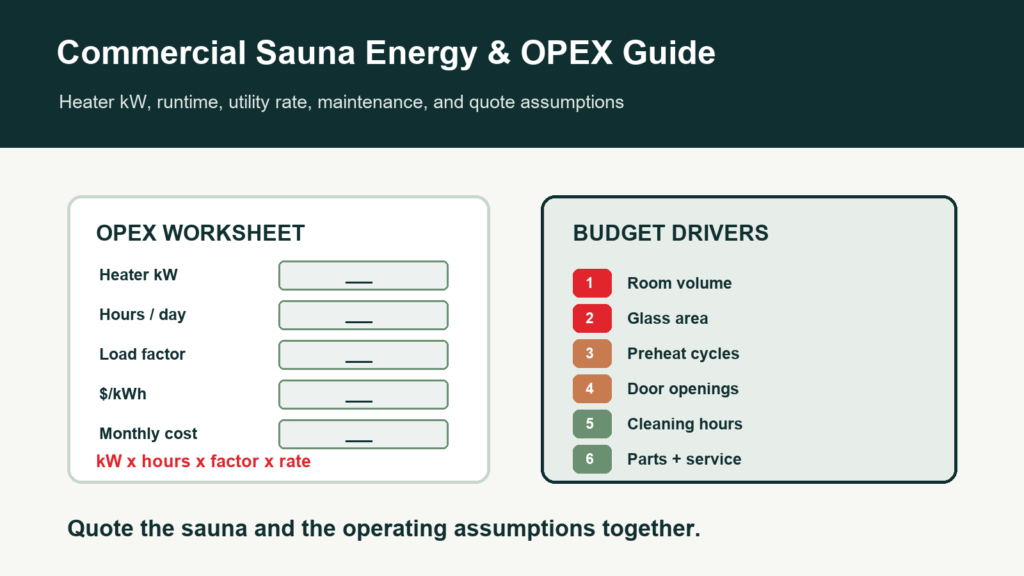
When we quote commercial sauna projects, buyers should quote the sauna and the operating assumptions together. Unit price matters, but hotels, gyms, apartments, spas, wellness clubs, and developers also need to understand heater rating, runtime, preheat cycles, cleaning hours, maintenance, spare parts, and who owns the operating budget.
This guide gives B2B buyers a practical way to discuss sauna energy use and operating cost with us. It is not an electrical design document and it is not a utility-bill guarantee. Final calculations should use local utility rates, site design, measured runtime, and qualified local professionals where electrical or code questions apply.
For the editable commercial sauna energy-use worksheet, send CSauna the facility type, room size, heater power, operating schedule, electricity rate, and expected guest load. No quote request is required for the worksheet.
The Basic Sauna Energy Formula
For planning, start with a scenario formula:
Estimated energy cost = heater kW x operating hours x load factor x local utility rate.
The most important point is that rated heater kW is not the same as actual energy use. The heater may cycle on and off after the room reaches set temperature. Actual consumption depends on room volume, insulation, glass area, door openings, preheat length, set temperature, ventilation context, controller behavior, use schedule, and maintenance condition.
Use this formula to compare scenarios, not to promise an exact bill. For a commercial sauna project, we recommend the buyer ask for assumptions and then refine them after installation through meter data, runtime logs, and monthly maintenance review.
Operating Cost Drivers
| Driver | Why It Changes OPEX | buyer file Question |
|---|---|---|
| Heater kW | Sets the connected load and the upper boundary for energy draw during heat-up. | Which heater rating is recommended for this room volume and glass area? |
| Room volume | Larger rooms usually need more heat and longer recovery time. | What room dimensions, bench layout, and capacity are assumed? |
| Glass area | More glass can change heat loss, warm-up time, comfort, and heater selection. | How does the glass-front design affect heater sizing and preheat expectation? |
| Operating schedule | A sauna used two hours daily is not budgeted like one open all day. | How many hours per day, days per month, and peak-use periods should be modeled? |
| Preheat cycles | Frequent cold starts can add cost and staff workload. | How long should preheat be planned before opening or peak use? |
| Door openings | High member or resident turnover changes recovery behavior. | What user load should be assumed for gyms, hotels, apartments, or spas? |
| Maintenance condition | Poor cleaning, blocked airflow, worn seals, or neglected parts can reduce performance. | What cleaning and maintenance logs should be kept? |
Example OPEX Worksheet for Buyers
Use your real local utility rate and site assumptions. Replace every blank before comparing suppliers:
| Worksheet Field | Buyer Input | Notes |
|---|---|---|
| Heater rated kW | ___ kW | Use the heater specified in the quote, not a generic number. |
| Operating hours per day | ___ hours | Separate preheat, member/resident use, cleaning, and standby if needed. |
| Open days per month | ___ days | Hotels and gyms may differ from seasonal resorts or apartment amenities. |
| Scenario load factor | ___ | Use an agreed planning assumption first, then replace with measured duty-cycle data later. |
| Local electricity rate | ___ per kWh | Use the buyer’s own utility tariff or facilities budget assumption. |
| Monthly energy scenario | ___ | kW x hours/day x days/month x load factor x rate. |
| Maintenance and parts reserve | ___ | Add cleaning, inspections, spare parts, service tickets, and replacement planning. |
Operating cost worksheet
Build monthly energy scenarios before comparing commercial sauna models
A commercial sauna buyer should not compare heater size alone. The project file needs a working scenario that separates preheat, open hours, traffic pattern, local electricity rate, and maintenance responsibility. The numbers below are planning fields, not guaranteed utility bills.
| Use case | Operating schedule to record | Cost model fields | Evidence to attach |
|---|---|---|---|
| Hotel or spa | Opening hours, preheat time before guest use, peak guest periods, housekeeping closeout, and off-season rules. | Heater kW, expected open days, load factor, glass area, room volume, target temperature, and local tariff. | Amenity schedule, room drawing, heater selection, controller note, cleaning log owner, and monthly meter review if available. |
| Fitness center | Morning/evening peaks, repeated door openings, staff inspection windows, and member access policy. | Heater kW, daily hours, estimated recovery load, duty-cycle assumption, ventilation note, and service-call reserve. | Peak traffic notes, door/bench layout, heater/control file, maintenance SLA, spare-parts list, and incident log template. |
| Apartment or condo | Resident booking rules, quiet hours, seasonal use, cleaning responsibility, and lockout/standby settings. | Monthly open days, tariff, controller schedule, average user sessions, warm-up policy, and inspection owner. | Amenity rules, property manager checklist, electrical note, signage draft, cleaning log, and warranty responsibility record. |
| Private facility or club | Reserved sessions, weekend peaks, staff reset time, and whether the room is heated continuously or by appointment. | Session length, preheat minutes, heater kW, standby assumption, local rate, and after-use ventilation/cleaning time. | Booking calendar, controller plan, operating handbook, safety signage, maintenance checklist, and replacement-parts note. |
| Worksheet line | How to calculate or confirm it | Common mistake | Buyer-file note |
|---|---|---|---|
| Monthly kWh scenario | Heater kW x operating hours per day x open days per month x agreed load factor. | Using connected heater kW as if the heater runs at full draw every minute after preheat. | Keep the first scenario conservative, then replace assumptions with meter or controller data after operation starts. |
| Monthly energy cost | Monthly kWh scenario x local electricity rate. Use the buyer’s own tariff, not a supplier estimate. | Comparing suppliers using a different electricity rate, currency, or operating schedule. | Record currency, tariff date, peak/off-peak rule, and whether tax or demand charges are excluded. |
| Preheat and recovery allowance | Add a separate line for cold starts, glass-front designs, door openings, and peak traffic recovery. | Treating a spa room, gym room, and apartment amenity as the same runtime model. | Attach use case notes so the model, heater, controller, and service plan match the real site. |
| Maintenance cost connection | Track cleaning, airflow, stones, seals, controls, and service tickets because they affect comfort and downtime. | Keeping energy cost in a separate spreadsheet from maintenance and service records. | Link the energy worksheet to the cleaning log, monthly inspection, spare-parts plan, and warranty file. |
Planning rule: compare scenarios before comparing model codes. A lower first price can still create a weaker project file if the heater path, glass area, operating schedule, controller rules, and service records are unclear.
How OPEX Questions Change by Buyer Type
| Buyer Type | OPEX Concern | Related CSauna Guide |
|---|---|---|
| Hotel or spa | Guest operating hours, housekeeping routine, premium experience, and downtime risk. | Commercial Saunas for Hotels and Spas |
| Fitness center | Peak use, repeated door openings, service SLA, and parts stock. | Gym Sauna Supplier Specification Guide |
| Apartment or condo | Resident rules, property operations, cleaning owner, and HOA budget expectations. | Apartment and Condo Sauna Amenity Guide |
| Developer or contractor | Submittal data, electrical assumptions, approval timeline, and handover files. | Commercial Sauna Project Submittal Checklist |
| Distributor or dealer | Repeatable model selection, support scripts, replacement parts, and buyer objections. | Spare Parts Minimum Stock Level Guide |
Energy and OPEX Buyer File Fields
Add these fields to the buyer file so the quote reflects the way the sauna will actually be operated:
- Buyer type, destination market, and project stage.
- Sauna type, room dimensions, target capacity, glass area, and insulation context.
- Heater rating, voltage and phase assumptions, controller preference, and approval questions.
- Expected operating hours, preheat schedule, peak-use periods, and open days per month.
- Local utility rate or budget rate for scenario modeling.
- Cleaning owner, daily inspection owner, monthly review owner, and service ticket owner.
- Spare-parts plan, service SLA boundary, and downtime review process.
- Whether the buyer needs a simple OPEX worksheet for internal approval.
Maintenance Items That Affect Operating Cost
Energy cost is not isolated from maintenance. Commercial sauna rooms should track cleaning, airflow, door fit, seals, stones, controls, heater condition, user behavior, and incident records. A neglected sauna can create higher service cost, poor guest experience, and avoidable downtime.
Use the Commercial Sauna Cleaning Log Template, Monthly Maintenance Review Template, Service SLA Guide, and Service Ticket Template to turn operating assumptions into records.
How we support Operating Cost Planning
We can help buyers define quote assumptions around sauna model, heater path, room size, glass area, user load, destination market, documentation needs, maintenance files, spare parts, and service workflow. The buyer should provide local utility rate, project operating schedule, and site-specific professional input where required.
Start with the contact page, then connect this guide with the Commercial Sauna Manufacturer, Product Specification Reference, Electrical Approval Checklist, and Supplier Trust Center.
Commercial Sauna Energy and OPEX FAQ
How do you estimate commercial sauna energy cost?
Use a scenario formula: heater rated kW multiplied by operating hours, an agreed load factor or measured duty cycle, and the local utility rate. Add preheat cycles, standby rules, cleaning hours, and maintenance assumptions for a fuller budget.
Is heater kW the same as actual energy use?
No. Rated kW is connected load. Actual energy use depends on preheat, room design, insulation, glass area, door openings, set temperature, use pattern, controls, and the measured or assumed duty cycle.
What should buyers ask suppliers for in an energy buyer file?
Ask for heater rating, recommended room volume, glass assumptions, control options, preheat expectations, operating schedule, documentation, maintenance requirements, and a scenario worksheet using the buyer’s local utility rate.
Can CSauna guarantee a utility bill amount?
No. Utility cost depends on site design, local rates, operating behavior, installation, and measurement. We can help define quote assumptions so buyers can model scenarios with their local professionals and utility data.
Cost and logistics worksheet
Commercial Sauna Energy Use and Operating Cost Guide Worksheet
This appendix turns the article into a practical B2B resource. Use it to collect buyer input, attach photos or screenshots, compare supplier replies, and keep an editable worksheet record for the project file.
Buyer input
Collect the exact model, site, document, photo, screenshot, and decision context before sharing the resource with another team.
Supplier or internal reply
Ask for a reply that states what is confirmed, what is missing, and what still needs local or buyer-side review.
Closeout record
Keep the worksheet with the buyer file so the same decision can be reused for future orders, service, training, or project handover.
Buyer working table
Use this table before sending the article to a buyer, dealer, project team, or supplier contact.
| Field | Buyer should record | Supplier or internal owner should confirm | Evidence to attach |
|---|---|---|---|
| Model and quantity scope | Record model code, product URL, quantity range, heater option, accessory scope, and private-label needs. | Confirm included items, excluded items, packing method, and any price-change trigger. | Product URL, quotation, product image, and accessory list. |
| Shipment route | Record destination country, port, warehouse, FCL/LCL/sample route, and delivery constraints. | Confirm carton count, CBM, gross weight, loading note, and document package. | Packing list, loading photo, freight note, and destination cost note. |
| Commercial terms | Record payment term, validity, delivery term, inspection need, and after-sales reserve. | Confirm what is fixed, what is estimated, and what must be checked locally. | Quotation PDF, invoice draft, broker note, and buyer spreadsheet. |
Photo, screenshot, and file evidence
Evidence should be named clearly so the same file can support supplier review, buyer education, service follow-up, or project handover.
| Evidence item | What it should show | When to collect it | File name example |
|---|---|---|---|
| Quotation screenshot | Unit price, included scope, payment term, shipment term, and validity. | Before comparing suppliers. | quote-scope-01.png |
| Packing or loading photo | Carton mark, crate condition, accessory boxes, and loading order. | Before shipment or when checking damage/shortage. | packing-loading-02.jpg |
| Destination cost note | Duty, broker, warehouse, inland delivery, inspection, and local handling. | Before landed-cost approval. | destination-cost-03.xlsx |
| Model reference page | The exact sauna model or nearest reference used in the cost sheet. | When cost depends on size, heater, glass, or wood. | model-reference-04.txt |
Reply and closeout table
The reply should help the buyer make a decision, not only repeat that the request has been received.
| Reply area | What the reply should include | Buyer follow-up |
|---|---|---|
| Cost scope reply | Separate product, packing, freight, document, and optional accessory assumptions. | Compare only like-for-like quotes. |
| Risk reply | Name the cost items that may change after model, route, label, or local requirement changes. | Add owner and deadline for each unknown. |
| Document reply | List invoice, packing list, manual, certificate, label, and loading photo availability. | Check with broker or buyer compliance team. |
Editable worksheet available
CSauna can share an editable worksheet version for this resource. Send a message with the article name, buyer type, target model or project context, and the fields your team wants to track.