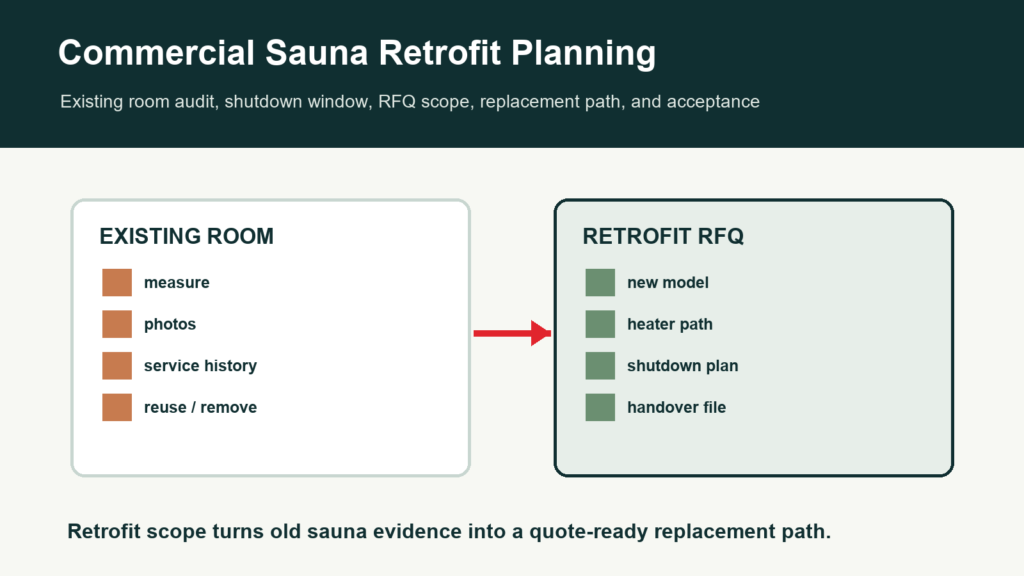
A commercial sauna renovation starts with evidence from the existing room. Hotels, gyms, apartments, spas, and wellness clubs often know they need a refresh or replacement before they know the correct buyer file scope. The buyer must define what stays, what changes, what shuts down, and what evidence is needed before CSauna can review the next step.
This guide helps facilities managers, property managers, contractors, developers, distributors, and commercial buyers prepare a retrofit or replacement buyer file for CSauna. Local code, electrical work, site inspection, demolition, and installation scope must be handled by qualified local professionals and the buyer’s project team.
Retrofit survey worksheet
Complete retrofit and renovation survey worksheet fields
Retrofit projects carry different risks from new-build sauna rooms. The buyer must document what stays, what is removed, what must match the existing opening, and which trade owns each unknown before a manufacturer can confirm the correct sauna direction.
| Survey area | Fields to collect | Why it matters |
|---|---|---|
| Existing room record | Current room size, doorway, ceiling height, wall/ceiling material, floor drain, bench layout, heater location, controller route, and photos from each wall. | Shows whether the project can reuse the room shell or needs a deeper rebuild. |
| Removal and reuse scope | Items to remove, items to keep, existing electrical feed, ventilation opening, floor condition, glass/door reuse, and access path for demolition and installation. | Prevents a replacement sauna quote from ignoring site constraints. |
| New product direction | Target model family, capacity, heater type, wood/finish, glass direction, door swing, bench layout, accessibility requirement, and service panel access. | Connects the renovation brief to real product pages and production drawings. |
| Risk and approval | Unknown wall condition, moisture risk, code question, landlord or owner approval, MEP review, schedule window, shutdown period, and inspection point. | Flags the decisions that must be closed before deposit or production. |
| Closeout file | Before photos, approved drawing, packing/access notes, installation photos, commissioning record, spare-part list, and maintenance handover. | Gives the facility team a clean record after the retrofit is complete. |
For the editable retrofit survey worksheet, record existing room photos, current dimensions, target model family, heater plan, and the items that must be reused or removed.
Renovation, Retrofit, Refresh or Replacement?
| Path | Typical Scope | Best Evidence |
|---|---|---|
| Refresh | Visible finish, bench parts, handles, signage, selected accessories, or minor user-facing improvements. | Photos, cleaning logs, user complaints, parts list, and closure window. |
| Retrofit | New sauna package or major components within an existing room or amenity area. | Room dimensions, site photos, existing heater/control data, access path, and contractor notes. |
| Replacement | Old sauna is removed and a new model, heater path, layout, or document package is selected. | Lifecycle budget, service history, downtime, target model, and buyer file scope. |
| Multi-location upgrade | Several hotels, gyms, or apartment properties standardize a new sauna package. | Installed fleet list, issue patterns, spare-parts history, and rollout timeline. |
Existing Sauna Audit Checklist
- Project type: hotel, spa, gym, apartment, condo, wellness club, resort, or commercial property.
- Existing sauna type, approximate age, model if known, heater/control details, and current condition.
- Room dimensions, ceiling height, bench layout, glass area, door direction, and access path.
- Photos of full room, heater area, controls, benches, glass, floor interface, vents, labels, and worn items.
- Service tickets, downtime, cleaning records, incident reports, annual review, and open punch-list items.
- What the buyer wants to reuse, remove, replace, or keep outside CSauna supply scope.
- Shutdown window, operating continuity needs, and target reopening date.
- Electrical, approval, contractor, landlord, HOA, or property-management constraints.
Retrofit Buyer File Fields
A renovation buyer file should be more specific than a new-Use checklist because the existing site creates constraints. Send:
| buyer file Field | Why It Matters |
|---|---|
| Existing room file | Shows what the supplier is being asked to fit, replace, or avoid. |
| Reuse/remove boundary | Prevents confusion over old room demolition, electrical work, trim, floor, glass, heater, controls, and local labor. |
| Target model path | Connects the retrofit to a standard CSauna model or custom commercial scope. |
| Shutdown window | Helps plan production, shipping, site work, handover, and reopening. |
| Document requirements | Supports contractor review, approval questions, facility files, and service handover. |
| Service history | Shows whether the new quote should solve repeated downtime, parts, cleaning, or user experience problems. |
Retrofit Risk Controls
- Do not quote only from room size: use photos, heater/control details, access path, and site notes.
- Separate supplier scope from local work: demolition, electrical, structural, waterproofing, ventilation context, and code review are usually local responsibilities unless otherwise agreed.
- Plan operations around downtime: hotels, gyms, and apartments need a shutdown window and communication plan.
- Protect the handover file: manuals, drawings, cleaning logs, spare parts, warranty evidence, and service routes must be ready before reopening.
- Use service history: repeated tickets and parts use should influence the new model, materials, heater path, and spare-parts plan.
How Retrofit Planning Connects to Lifecycle Budget
A retrofit is often triggered by lifecycle evidence: rising downtime, repeated service tickets, higher OPEX, worn user-facing parts, renovation calendar, or brand-standard changes. Use the Commercial Sauna Lifecycle Budget Plan, Sauna Facilities KPI Dashboard, and Commercial Sauna Energy and OPEX Guide when preparing the replacement scope file.
For acceptance, connect the scope file with the Commercial Sauna Commissioning Punch List, Opening-Day Checklist, and contact page.
Retrofit Factory Review Notes
CSauna can help buyers turn existing room evidence into a complete sauna replacement or refresh scope. Prepare the existing room file, target model, service history, shutdown window, document needs, spare-parts concerns, and destination-market approval questions. The factory review can then cover product scope, packaging, documentation, compatible parts, and supplier-side handover support.
For multi-property buyers, send a location matrix so the new model path can be standardized across hotels, gyms, apartments, or wellness clubs.
Commercial Sauna Retrofit FAQ
What should be included in a commercial sauna retrofit buyer file?
Include existing room photos, dimensions, heater and control details, service history, what will be reused or removed, shutdown window, approval questions, target model, and handover requirements.
Is a sauna renovation the same as a replacement?
No. A renovation may refresh parts of the room, while replacement usually changes the sauna package, heater path, layout, documents, or service assumptions. The buyer file should define the intended scope.
Who should inspect an existing sauna before retrofit?
The buyer should involve the facilities manager, contractor, qualified local professionals for electrical or code questions, and the supplier or dealer for model and parts review.
Can CSauna review retrofit photos only?
Photos help start the discussion, but a reliable retrofit review also needs dimensions, site constraints, existing heater/control details, target operating use, service history, and local approval requirements.
Product reference table for this resource
Use this table when the article needs to connect back to a real CSauna model page, project screenshot, or buyer evidence file. It keeps the resource useful without turning it into a sales block.
| Reference field | What to record | Evidence to attach | How the buyer uses it |
|---|---|---|---|
| CSauna product catalog | Shortlist one or more model pages that match the Commercial Sauna Retrofit Planning Guide discussion. | Product URL, model code, screenshot, and buyer note. | Keeps the resource tied to real models rather than generic advice. |
| Model comparison note | Record capacity, heater route, glass, wood, packing, site fit, and service needs. | Marked screenshot, product photo, label photo, or worksheet row. | Helps the buyer compare options with the same fields. |
| Closeout record | Record the selected model reference, open question, owner, and next review date. | Worksheet, email note, photo folder, or internal project file. | Makes the article usable for handover, not just reading. |
Commercial retrofit appendix
Retrofit survey worksheet for commercial sauna rooms
A retrofit quote becomes much cleaner when the buyer records what exists, what must stay, what must be removed, and what must be approved before new sauna materials or equipment are selected.
Existing-room survey table
| Survey item | What to document | Why it matters | Evidence to attach |
|---|---|---|---|
| Room envelope | Interior size, ceiling height, existing wall/floor/ceiling material, visible damage, and moisture marks. | Defines whether the project is cosmetic refresh, partial rebuild, or full room replacement. | Wide room photos, measurement sketch, moisture/problem close-ups. |
| Heater and control system | Existing heater type, kW, voltage, controller location, sensor position, breaker notes, and user complaints. | Determines whether the project can reuse electrical assumptions or needs a new technical review. | Heater label, controller photo, electrical panel note if safe, temperature log. |
| Door, glass, and access | Door swing, glass size, hinge side, threshold, service access, ADA or local access notes. | A retrofit can fail if the new layout conflicts with circulation, cleaning, or service access. | Door photos, opening dimensions, access path photo. |
| Operations during renovation | Shutdown window, guest/member communication, temporary closure area, contractor access, and noise restrictions. | Commercial buyers need a renovation plan that fits business operations. | Calendar, site rules, facility manager contact, contractor access note. |
Retrofit decision log
| Decision | Owner | Approval needed before factory review | Handoff record |
|---|---|---|---|
| Reuse or replace heater | Facility manager plus qualified local reviewer. | Existing heater label, performance issue, safety concern, and local electrical review. | Decision note, label photo, and any electrician/HVAC comments. |
| Keep existing room footprint | Owner, architect, or contractor. | Updated dimensions, door swing, bench target, and code/access assumptions. | Sketch or drawing with dated approval. |
| Change finish or bench layout | Buyer and design team. | Material preference, cleaning expectation, commercial traffic level, and reference images. | Finish direction, bench drawing, maintenance note. |
| Schedule shutdown | Facility operations manager. | Final installation window, contractor access, guest/member communication, and reopen checklist. | Shutdown plan and reopen sign-off owner. |
How the project team should use this appendix
- Separate cosmetic refresh from functional replacement before asking for commercial terms.
- Keep photos of the existing room in the same folder as the new model reference.
- Do not promise a heater or control reuse plan until qualified local review is complete.
Retrofit decision appendix
Retrofit readiness scorecard for existing sauna rooms
A retrofit is not only a new sauna quote. It is a decision about what can stay, what must be removed, which local professionals must review the site, and what the buyer expects after reopening.
Retrofit readiness scorecard
| Readiness area | Green signal | Yellow signal | Red signal |
|---|---|---|---|
| Existing structure | Room dimensions, wall/floor/ceiling condition, and access path are documented. | Some areas are unclear but inspection is scheduled. | Moisture, damage, or unknown hidden structure prevents reliable scope. |
| Technical systems | Heater/control/electrical/HVAC notes are clear and local review owner is named. | Labels are available but local review is pending. | Buyer expects supplier to approve electrical/HVAC without local professional review. |
| Operations plan | Shutdown window, contractor access, and reopening checklist are realistic. | Schedule is tight but decision owners are identified. | No closure plan or site access plan exists. |
| Buyer outcome | Buyer agrees whether the goal is repair, refresh, layout change, or full replacement. | Buyer still comparing visual direction. | Buyer asks for price before defining success criteria. |
Retrofit evidence package
| Evidence | Minimum file | Why it matters | Who supplies it |
|---|---|---|---|
| Existing room photos | Wide shots, problem areas, door/glass, heater/control, floor/base, adjacent spaces. | Defines current condition and avoids quoting from a cropped image. | Buyer or site manager. |
| Measured sketch | Interior size, ceiling height, door opening, bench direction, equipment location. | Prevents retrofit quote from using old or assumed dimensions. | Contractor, architect, or buyer team. |
| Risk review notes | Moisture, electrical, HVAC, access, cleaning, code or operational concerns. | Separates product quote from local professional responsibilities. | Qualified local reviewer. |
| Reopening file | Commissioning checklist, cleaning plan, staff instruction, service owner. | Makes the completed retrofit usable, not just installed. | Facility manager. |
How buyers should use this planning file
- Retrofit buyers should define success before comparing product options.
- Do not use old room dimensions without a current measured sketch and photo set.
- Separate visual refresh decisions from safety, electrical, ventilation, and moisture responsibility.