Compliance Evidence
Compliance file preview
Turn certification questions into an evidence checklist.
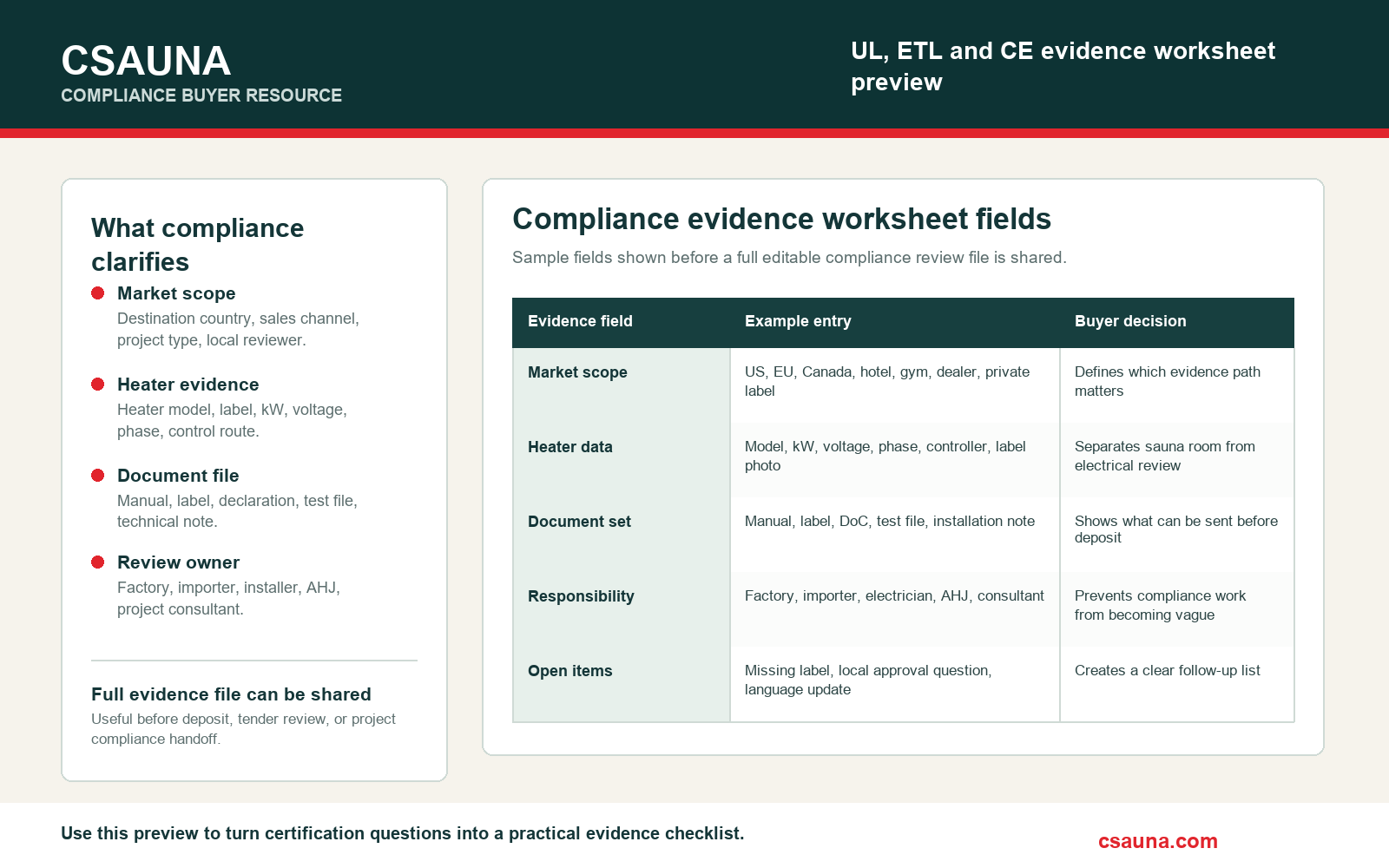
This preview shows the compliance fields a buyer can collect before deposit or tender review: destination market, heater data, document set, local responsibility, and open approval questions.
- Use it before deposit, tender review, project compliance handoff, or local installer discussion.
- Attach heater label, controller route, manual language, declaration, and local reviewer questions where available.
- The complete editable evidence file can be shared when the destination market and project scope are known.
No quote request is required for the evidence file. It is a buyer-side compliance review template.
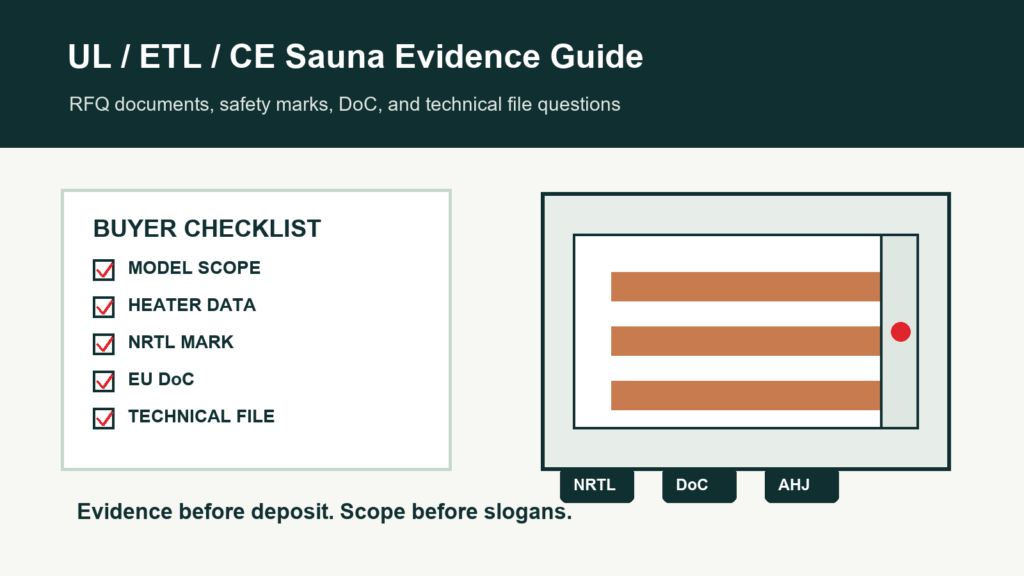
UL, ETL and CE sauna compliance evidence guide
Compliance evidence should be managed as a document file tied to the sauna model, heater package, voltage, market, and project requirement. Buyers should confirm what evidence is available before production and shipment.
The CSauna certification and compliance record groups the evidence categories currently available for buyer review. Final applicability remains tied to the model, heater package, voltage, and destination requirements.
Evidence depends on scope and market.
A sauna room can include structure, wood, glass, heater, controller, lighting, labels, manuals, packing, and accessories. Different markets and project buyers may require different evidence for different parts.
This guide helps importers and project buyers ask clearer document questions without relying on vague compliance promises.
1. Evidence scope map
Start by naming what the document should prove.
| Scope | Possible evidence | Buyer question | Factory answer |
|---|---|---|---|
| Heater and control | UL, ETL, CE, SAA or supplier documents where available | Which exact heater package? | Brand, voltage, power, control version |
| Sauna room | Material, drawing, inspection photos, manuals | What is included in room evidence? | Model and production file |
| Electrical accessories | Lighting, transformer, controller labels | Which voltage and market? | Electrical note |
| Wood material | Origin, import, PEFC/FSC where relevant | Which species and grade? | Material file |
| Packing and labels | Carton marks, rating labels, warning labels | Which language and market? | Label file |
| Project documents | Submittal, inspection checklist, handover file | What does the project require? | Document list |
2. Document request fields
Document requests should be specific enough for the supplier to answer.
| Field | What to ask | Why it matters | Weak request |
|---|---|---|---|
| Destination market | Country and installation type | Controls document expectation | Do you have certificates? |
| Product scope | Room only, heater, accessories, full project file | Avoids mismatched evidence | Send all documents |
| Heater package | Brand, voltage, kW, controller | Compliance often follows heater package | Use standard heater |
| Label language | English or local language | Affects manuals and warning labels | Normal labels |
| Project buyer need | Tender, import, site, reseller, or owner record | Changes file depth | For approval |
| Timing | Before quote, before production, before shipment | Prevents late surprises | Send later |
3. Evidence review checklist
Review documents for match, not just existence.
| Review point | What to check | Evidence | Risk |
|---|---|---|---|
| Model match | Document matches product or heater version | Model name or technical description | Wrong product basis |
| Voltage match | Voltage and phase match destination | Electrical label or spec | Wrong market package |
| Date and validity | Document is current enough for buyer needs | Document date | Outdated file |
| Scope limit | Document covers part, not necessarily full room | Scope text | Overclaiming |
| Label consistency | Manual, rating, carton, warning labels align | Label files | Receiving or inspection issue |
| Translation need | Buyer language and project format | Manual version | Late document rework |
4. Compliance file handoff
The document file should be attached to the order, not sent in scattered messages.
| Handoff item | What it includes | Owner | When sent |
|---|---|---|---|
| Document list | Available certificates and scope | Factory sales | Before order confirmation |
| Heater spec | Voltage, kW, controller, label | Technical team | Before heater lock |
| Manuals | Use, installation, safety notes | Factory and buyer | Before shipment |
| Labels | Rating, warning, carton marks | Buyer and factory | Before packing |
| Inspection photos | Production and packing evidence | QC | Before shipment |
| Final archive | All files in one folder | Importer | At shipment |
Buyer file fields to keep visible
A good procurement or compliance article should become a buyer file. Keep the approved fields visible so sales, design, warehouse, installer, and service teams can use the same facts.
| Field | Why it matters | Who uses it | When to update |
|---|---|---|---|
| Model code | Connects the discussion to a real sauna room | Buyer, dealer, factory sales | When the selected model changes |
| Approved drawing | Confirms size, door, glass, bench, heater, and ventilation | Designer, installer, project owner | Whenever layout changes |
| Material record | Names wood, roof, exterior finish, glass, and hardware | Buyer and design team | Before visible material is cut |
| Electrical note | Records voltage, phase, heater power, controller, and market assumptions | Importer and electrician | Before heater package is locked |
| Packing file | Shows cartons, labels, manuals, spare parts, and accessory scope | Warehouse and buyer | Before shipment |
| Service file | Keeps photos, issue notes, replacement decisions, and owners | Dealer and after-sales team | At handover and after service |
Decision owners
Many project delays happen because no one owns an open field. Name the owner for each decision so the file moves instead of becoming a chain of messages.
| Decision | Factory confirms | Buyer or local team confirms | Output |
|---|---|---|---|
| Room family | Feasible model and customization range | Use case, budget, site size | Model shortlist |
| Material | Wood options, finish availability, certificate support | Visual preference, climate, premium requirement | Material approval |
| Electrical | Heater package and controller options | Local voltage, installer, compliance expectation | Electrical note |
| Documents | Available certificates, manuals, packing evidence | Import, project, or tender requirement | Document list |
| Packing | Carton count, labels, loading photos | Receiving site and warehouse process | Packing file |
| Service | Compatible parts and evidence needed | Local support process and owner | After-sales file |
Repeat-order review
After the first order, use the file to improve the next order. The review should identify which fields were unclear, which documents were late, and which support questions repeated.
| Timing | Review question | Evidence | Next action |
|---|---|---|---|
| Before production | Were all material, electrical, and drawing fields confirmed? | Approved option sheet | Lock or revise |
| Before shipment | Were labels, manuals, accessories, and spare parts clear? | Packing list and photos | Approve shipment |
| After arrival | Were cartons easy to identify and undamaged? | Receiving photos | Improve labels or packing |
| After installation | Were site, heater, and handover notes sufficient? | Installed photos and issue notes | Update installer file |
| After first month | What questions did staff, dealers, or users ask? | Service log | Update training |
| Before reorder | Which model, option, or document should change? | Sales and service records | Revise next order file |
Good document requests
- Name destination
- Name product scope
- Name heater package
- Ask for document scope
- Review label consistency
Weak compliance claims
- Certified without scope
- No voltage match
- No label version
- No document date
- No project requirement
Model references used in this guide
Use real model pages as the starting point, such as CSA-05 commercial cedar sauna room, CSA-06 red cedar outdoor sauna kit for hotels, and CSA-08 black hemlock square sauna.
Factory note
Compliance conversations should be factual and scoped. A clear document list builds more trust than broad claims, especially when the buyer is importing or submitting a project file.
Working note for buyer teams
The first version of this file should mark open fields clearly. If the voltage, document requirement, material certificate, packing label, accessory scope, or service owner is not confirmed yet, write that into the file. Open fields are manageable; hidden assumptions become cost, delay, or trust problems.
For repeat orders, keep the same structure and update only the facts. That gives the buyer and factory a stable language for model, material, electrical, compliance, packing, installation, and after-sales decisions.
Responsibility boundaries to confirm
Before the file is shared with a project buyer or distributor, name which party owns each open decision. The factory can confirm product structure, available materials, heater package options, packing evidence, and compatible parts. The importer, project owner, or dealer usually owns the local site, code review, installer coordination, operating rules, and final customer communication. If those boundaries are not written down, a technical question can turn into a commercial dispute.
For higher-value projects, add an owner column to the working sheet. The owner can be a person, department, or outside contractor, but it should be visible. This keeps the file moving because everyone can see who must answer before the model, document, electrical, packing, or handover step is considered complete.
When a field is still undecided, keep it visible until it is closed. Typical open fields include final voltage, local installer review, label language, material certificate request, private-label artwork, carton mark, spare-parts scope, and handover owner. Closing these fields early makes production, shipment, and service much cleaner.
Record the decision date and owner beside each closed item before rollout.
Editable buyer workbook
Compliance evidence workbook fields
Compliance review is easier when the buyer separates product evidence, electrical responsibility, label language, and local approval questions. The worksheet below keeps UL, ETL, CE, and project-specific evidence from becoming a vague certificate request.
| Field group | What to record | Why it matters |
|---|---|---|
| Market route | Destination country or state, indoor/outdoor use, commercial or residential duty, voltage route, and local inspector or installer role. | Defines which evidence matters before the supplier prepares files. |
| Product identity | Model code, heater model, controller, electrical accessories, glass/door parts, and manual language. | Prevents certificate questions from being asked against an unclear product package. |
| Evidence file | Available certificate, test report, label photo, manual, wiring note, installation guide, and warning label. | Lets buyers see what can be supplied as a document package. |
| Local responsibility | Permit, breaker, wire gauge, site inspection, electrician sign-off, and authority having jurisdiction question. | Avoids treating local code approval as a factory promise. |
| Revision control | Changed heater, changed controller, changed voltage, changed room size, changed label, and who approved the revision. | Keeps compliance evidence aligned after product changes. |
| Open questions | Missing file, unclear certificate scope, local interpretation, commercial-use concern, and next owner. | Makes unresolved compliance risk visible before ordering. |
For a complete editable compliance workbook, ask for the evidence sheet and include destination market, heater route, and inspection questions.
Need an editable compliance evidence checklist?
Send the destination market, heater package, and document need. We can prepare an editable evidence checklist for buyer review.