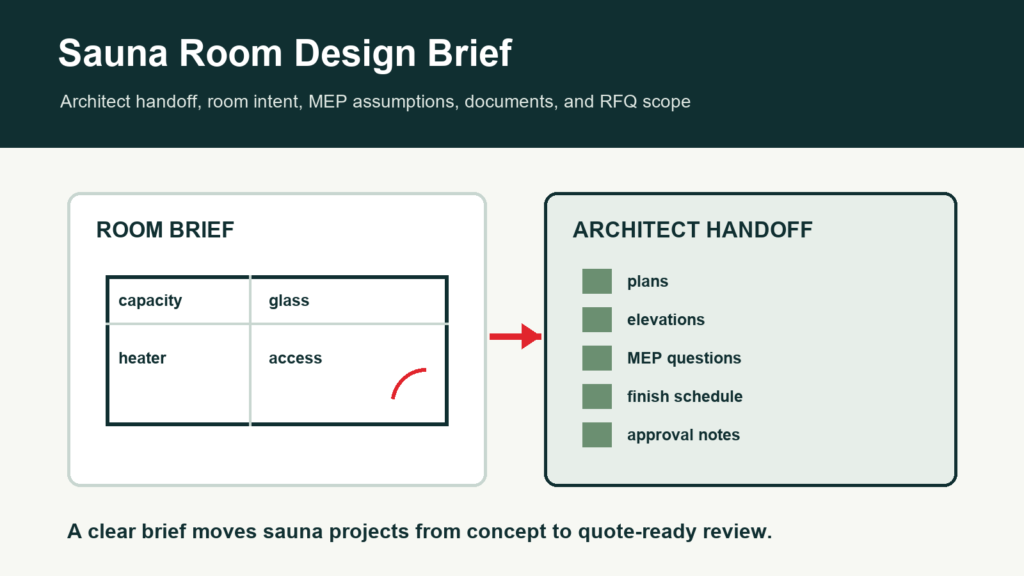
A sauna-room brief turns an early wellness idea into a file that an architect, buyer, installer, and factory can discuss without guessing. It is useful for hotels, spas, gyms, apartments, resorts, showrooms, renovations, and commercial wellness projects. The brief does not replace local design, electrical, structural, waterproofing, ventilation, fire-safety, or permit decisions; it makes the project questions visible early enough to assign them correctly.
Define the project before selecting a model
Record the project type, decision owner, intended user load, operating pattern, location, target opening date, and whether the work is a new build or renovation. Then describe the room: available dimensions, ceiling height, door and circulation path, glass direction, bench arrangement, adjacent walls, floor/base condition, service access, delivery route, and maintenance expectations. A product image or preliminary layout is not a production drawing.
Core design brief fields
| Design area | Information to capture | Decision owner |
|---|---|---|
| Room and user plan | Interior and exterior dimensions, ceiling, capacity, user circulation, operating hours, cleaning and maintenance access. | Buyer project team and architect. |
| Layout and envelope | Door swing, glass, bench geometry, wall and roof context, floor/base, drainage, outdoor exposure, and delivery path. | Architect, contractor, and responsible site team. |
| Heating and electrical route | Heater direction, voltage question, controller location, cable route, ventilation and clearances to be reviewed. | Qualified local electrical/installation professionals with buyer approval. |
| Materials and finish | Wood or finish direction, glass, hardware, lighting, branding, and any project sample requirements. | Buyer/design team; factory confirms available scope. |
| Drawing and approvals | Concept, coordination drawing, factory review, installer review, final approved production file, and revision owner. | Named buyer project owner. |
Separate the design brief from the final order scope
Early drawings help compare layout options. Before production, the selected configuration still needs a dated order file covering model or room reference, dimensions, materials, heater and control route, glass and door direction, packaging, labels, manuals, accessories, document questions, and approvals. If a site condition or design revision changes, update the file rather than relying on an older concept drawing.
Ask the practical handoff questions
| Project question | Why it must be answered |
|---|---|
| Where will users enter, sit, circulate, clean, and receive service? | A room can fit on a plan yet be difficult to operate or maintain. |
| What site conditions affect the sauna body, glass, roof, drainage, ventilation, and electrical route? | The supplier needs factual site assumptions; local professionals decide the final installation approach. |
| Which items are factory-supplied and which are site-supplied? | Prevents gaps between sauna body, electrical connection, ventilation, base, local installation, and project handover. |
| Which drawing and revision control the order? | Keeps the buyer, factory, contractor, and installer aligned when details change. |
Prepare a usable drawing package
Give the project team a clearly named drawing version, room measurements, elevations where needed, door and glass direction, bench layout, heater/control question, material direction, and notes on access, base, drainage, ventilation, and site services. Attach photographs of the actual room or site where useful. Identify open decisions rather than hiding them in a generic request for a quote.
Handoff and responsibility boundary
CSauna can review factual selected-model, material, component, packing, and available drawing information for an order scope. The buyer and its responsible local professionals retain decisions about site suitability, electrical work, ventilation, waterproofing, structure, installation, safety, permits, and local compliance. A complete brief is valuable because it makes those ownership boundaries explicit before production, delivery, and installation.
Working file preview: project brief register
Use this register as the first page of the project handoff file. It gives each party a place to record what is known, what is still open, and which drawing or message controls the next decision. It is deliberately practical: it does not replace the work of the project architect, installer, electrical contractor, structural professional, local authority, or other responsible party.
| Register item | Record before factory review | Status to show | Owner |
|---|---|---|---|
| Project identity | Project name, city/country, project type, buyer contact, intended opening date and revision date. | Confirmed / open | Buyer project owner |
| Selected reference | Model or room reference, source image or drawing number, capacity intent and intended use. | Reference only / approved for coordination | Buyer and design team |
| Room envelope | Available width, depth, height, wall and floor condition, access route, door clearance and nearby services. | Site information supplied / site review pending | Architect or site team |
| Product direction | Wood/finish direction, glass position, bench layout, door direction, roof/exterior exposure and accessory choices. | Selected / alternatives under review | Buyer/design team |
| Electrical and services | Destination, local electrical question, heater/control route, service access, ventilation and drainage coordination questions. | Local professional review required / resolved | Buyer with qualified local professionals |
| Order control | Approved drawing version, change date, open-point log, sign-off contact and factory review response. | Not for production / approved order file | Named buyer decision owner |
Collect site facts before asking for a revised layout
When a project changes from a catalog reference to a room-specific discussion, missing site facts create most of the rework. The buyer can keep the request precise by sending measured photographs, a simple plan, a ceiling-height note, the intended door and glass direction, and a list of fixed constraints such as columns, service penetrations, windows, drains, delivery access, or existing finishes. Mark estimates as estimates. A photograph should support a measurement, not replace one.
- State whether the room is indoors, outdoors, partially exposed, new construction, or a renovation.
- Record the clear space around the intended sauna area, not only the nominal room size.
- Show the route from unloading point to final location, including stairs, turns, lifts, gates, and door openings.
- Identify which walls, floor finishes, roof details, drains, ventilation routes, and electrical services already exist.
- Specify the target market and project timing without assuming a universal electrical, installation, or compliance solution.
- Name one person who can confirm the final drawing revision for the buyer team.
Coordinate decisions in the right order
Not every choice needs to be final on the first call. The useful sequence is to confirm the room and access facts first, select the general sauna direction second, then coordinate the product configuration with the project services and the final order file. This keeps a concept image from being mistaken for a production commitment.
| Stage | Useful output | Do not treat it as |
|---|---|---|
| Initial brief | Room facts, intended use, buyer priorities and open constraints. | A final site survey or installation approval. |
| Layout coordination | Working dimensions, door/glass direction, bench intent and product options to discuss. | A production drawing before the order scope is agreed. |
| Technical coordination | Questions for local electrical, ventilation, drainage, structure, waterproofing and installation professionals. | Factory advice substituting for local project responsibility. |
| Order confirmation | Dated selected model, approved configuration, factory-supplied scope, packing and documentation notes. | Permission to ignore later site or project changes. |
| Handoff | Approved file, delivered-item check, manuals/labels where applicable and named after-sales contact. | A blanket record for a different configuration or later project. |
Run an open-point log instead of hiding assumptions
For each unresolved issue, write a short question, the drawing or photo it relates to, the person who owns the answer, and a due date. Examples include final site dimensions, local electrical connection, ventilation route, base or drainage preparation, glass/door direction, packaging access, manual language, and whether a chosen accessory changes the selected configuration. Close an item only when the responsible person records the decision in the current revision.
What to send for a focused factory review
A focused review package contains the current brief register, room plan or sketches, dated photos where relevant, the requested product direction, target destination, desired delivery timing, and a clear list of questions. CSauna can respond to the selected model, materials, available components, packing considerations, and order-file questions within the agreed scope. Local site suitability, electrical work, ventilation, waterproofing, structural work, installation, permits, safety decisions, and compliance responsibility remain with the buyer and the qualified local professionals responsible for the project.