Tender Specification
Project file preview
Turn commercial sauna requirements into a project handoff.
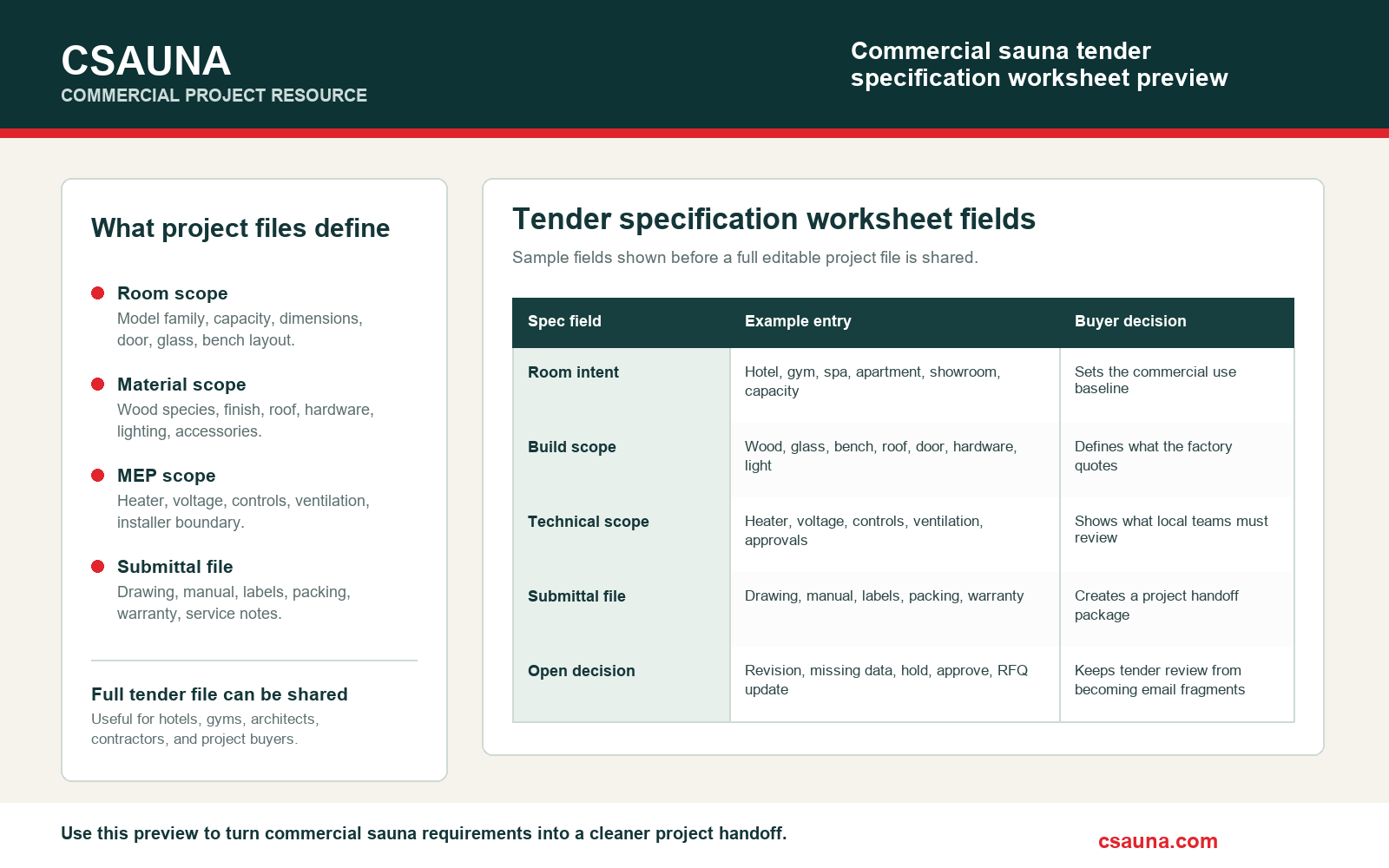
This preview shows the tender fields a hotel, gym, architect, contractor, or project buyer can align before quote review: room scope, material scope, MEP scope, submittal file, and open decisions.
- Use it for hotels, gyms, spas, apartments, architects, contractors, and commercial project buyers.
- Attach room intent, wood direction, glass and door notes, heater route, voltage, packing, and warranty requirements.
- The complete editable tender file can be shared when the project type and drawing stage are known.
No quote request is required for the tender file. It is a buyer-side project handoff template.
Commercial sauna tender specification template
A tender specification should make suppliers quote the same sauna basis: room type, dimensions, wood, heater, glass, ventilation, accessories, documents, packing, and after-sales support.
Make comparison fair before price is reviewed.
Many tender files compare prices before the sauna basis is clear. One supplier quotes red cedar, another quotes hemlock, one includes heater and controller, another excludes accessories, and the buyer sees only a unit price.
This template gives project buyers a clearer structure so hotel, spa, gym, and contractor teams can compare supplier responses without losing technical detail.
1. Room and model basis
Begin with the room itself. This prevents suppliers from quoting different products under the same tender name.
| Field | Buyer should specify | Supplier should confirm | Reason |
|---|---|---|---|
| Room type | Barrel, cabin, cube, indoor room, commercial room, infrared, or custom | Closest model and customization limits | Defines product family |
| Capacity | Target users and use type | Interior layout and bench count | Controls size and heater |
| Dimensions | Exterior and site limits | Final exterior and interior size | Stops drawing disputes |
| Door and glass | Opening direction, glass area, frame, handle | Door package and hardware | Controls installation |
| Bench layout | Single tier, double tier, L shape, facing benches | Bench materials and supports | Affects comfort and maintenance |
| Ventilation | Basic requirement and site restrictions | Air inlet/outlet position | Affects heat movement |
2. Material specification
Wood choice is central to buyer perception and project cost. Tender language should name the material rather than only saying premium wood.
| Material field | Options to name | Supplier evidence | Review note |
|---|---|---|---|
| Interior wood | Red cedar, thermo hemlock, hemlock, pine, thermo pine, hinoki, Japanese cedar, rustic cedar | Material note or certificate where relevant | Match budget and climate |
| Exterior finish | Natural wood, black finish, roof color, metal trim, shingles | Finish sample or photo reference | Outdoor rooms need stronger clarity |
| Glass | Tempered glass thickness and layout | Glass specification | Affects door and seal parts |
| Hardware | Hinge, handle, clips, screws, visible metal tone | Hardware list | Small parts affect perception |
| Surface treatment | Oil, heat treatment, exterior protection | Treatment note | Important for outdoor exposure |
| Certificate need | Origin, import, PEFC/FSC, inspection report when required | Available documents | Confirm before procurement |
3. Heater, voltage, and controls
Electrical differences should be named inside the tender, especially for importers buying across regions.
| Item | Tender requirement | Supplier confirmation | Risk if vague |
|---|---|---|---|
| Heater type | Electric, wood-fired, infrared, or project-specific | Brand, power, guard, stone capacity | Wrong heating basis |
| Voltage | EU, US, Southeast Asia, or destination standard | Voltage, phase, control package | Wrong market wiring |
| Power | Room volume and commercial use assumption | kW and heat-up guidance | Slow or unstable heating |
| Controller | Inside/outside control, timer, sensor | Control layout and service access | Difficult operation |
| Lighting | Lamp or LED type and voltage | Transformer and placement | Unsafe or unserviceable light |
| Compliance | CE, ETL, SAA, ISO, inspection support where needed | Document availability | Late paperwork dispute |
4. Commercial and logistics scope
A tender should include logistics and service expectations, otherwise suppliers may quote different delivery bases.
| Scope | Buyer should ask | Supplier should answer | Document |
|---|---|---|---|
| MOQ and sample | Sample policy, distributor start quantity | Minimum order and sample basis | Commercial note |
| Packing | Carton mark, labels, manuals, accessory carton, spare parts | Packing method and photos | Packing list |
| Shipping basis | FOB, container, destination port, loading needs | CBM and loading plan | Logistics file |
| Private label | Logo, manual, label, carton mark, SKU naming | Artwork and approval timing | Brand file |
| Spare parts | Starter kit, warranty parts, maintenance stock | Parts list and compatibility fields | Parts file |
| After-sales | Response process and evidence requirements | Service workflow | Warranty file |
How buyers should use this document
The document should sit inside the buyer file rather than live only as a web article. Each buyer role uses it differently, so the working sheet should name the owner, the decision date, and the next action. This makes the resource practical for procurement, dealer training, project installation, and future service review.
| Buyer role | Use this document for | Fields to keep visible | Next action |
|---|---|---|---|
| Importer | Compare supplier readiness beyond first unit price | Model, material, voltage, documents, packing, spare parts | Attach to supplier comparison file |
| Distributor | Build a repeatable dealer or SKU program | Model family, stock plan, service process, training owner | Turn into internal operating sheet |
| Dealer | Explain models consistently and avoid wrong promises | Product page, drawing, accessories, warranty and installation notes | Use during customer handover |
| Commercial buyer | Coordinate hotel, gym, spa, or resort stakeholders | Approved drawing, site owner, maintenance owner, evidence record | Attach to project folder |
| Installer | Check site, access, power, and final room condition | Dimensions, door direction, heater notes, installed photos | Complete handover record |
| Service team | Resolve future questions with dated evidence | Claim photos, part codes, installed model, previous action | Update case history |
Review cadence after the first order
A resource file becomes stronger after the first order ships, installs, and produces real feedback. The buyer should review what was clear, what was missing, and what caused extra messages. That review helps the next container, project, or dealer rollout become simpler.
| Timing | What to review | Evidence to check | Decision to make |
|---|---|---|---|
| Before production | Confirm all model, material, heater, and document decisions | Approved drawing and option sheet | Lock or revise the file |
| Before shipment | Check cartons, labels, accessories, spare parts, and manuals | Packing list and photos | Approve loading and documents |
| After arrival | Record damage, missing items, or installation questions | Carton photos and receiving notes | Separate logistics from product issues |
| After installation | Check function, site fit, and buyer handover | Installed photos and test notes | Update installation guidance |
| After first month | Review service questions and staff feedback | Issue log and maintenance notes | Update training or spare parts |
| Before repeat order | Remove slow-moving items and strengthen weak fields | Sales, warranty, and warehouse records | Revise next-order file |
Evidence to keep in the buyer file
A good B2B resource page should improve the buyer file. Keep the approved facts where the factory, buyer, warehouse, installer, and service team can all see them later.
The most useful files include the model page, approved drawing, material record, heater and voltage notes, packing list, installed photos, and any service or change history. This reduces arguments months after delivery because the answer is connected to a dated file.
| Evidence item | What it proves | Who uses it | When to update |
|---|---|---|---|
| Model page | The visual model and public reference selected by the buyer | Buyer, dealer, factory sales | When the model family changes |
| Approved drawing | Size, door, glass, bench, heater, ventilation, and accessory position | Design, installer, project owner | Whenever layout changes |
| Material record | Wood species, roof, exterior finish, hardware tone, and certificate needs | Buyer and design team | Before production material is cut |
| Electrical note | Voltage, phase, heater power, controller position, and market standard | Importer and electrician | Before heater package is locked |
| Packing file | Carton order, accessory carton, spare-parts carton, labels, manuals, and loading notes | Warehouse and buyer | Before shipment |
| Installed or handover photos | What was actually delivered and installed | Dealer, service team, facility manager | At installation and after service work |
Tender language that helps
- Name the wood species
- State voltage and market
- Separate included and optional accessories
- Request packing evidence
- Ask for model-specific spare parts
Tender language to avoid
- Premium sauna without material basis
- Best heater without voltage
- Accessories included without list
- Certification available without document names
- Customizable without approval process
Model references used in this guide
Use actual model pages as the anchor for the file, for example CSA-05 commercial cedar sauna room, CSA-06 red cedar outdoor sauna kit for hotels, and CSA-08 black hemlock square sauna.
Factory note
For repeat orders, the strongest buyer files are the ones that stay close to the actual room being produced. Keep the model code, final drawing, material decision, heater package, packing notes, and service evidence together. That makes future quotation, production, installation, and replacement-parts work faster and less dependent on memory.
Editable buyer workbook
Tender specification workbook fields
A tender specification should help suppliers respond to the same requirement instead of guessing from a mood image. CSauna recommends writing the room, material, electrical, evidence, and handover scope in separate fields.
| Field group | What to record | Why it matters |
|---|---|---|
| Scope summary | Project type, room count, indoor/outdoor use, capacity, target models, deadline, delivery country, and commercial-duty expectation. | Gives suppliers the same basic context before they quote. |
| Room requirement | Exterior size, interior height, bench layout, door swing, glass side, roof direction, ventilation, and access constraints. | Makes the tender checkable against drawings and site limits. |
| Material requirement | Wood species, origin preference, finish tone, roof material, glass color, hardware, lighting, and certificate or origin file request. | Keeps material comparison objective rather than visual only. |
| Electrical requirement | Voltage, phase, heater kW expectation, controller, sensor, local electrician role, labels, and manual language. | Clarifies what is supplied by factory and what is reviewed locally. |
| Supplier evidence | Factory photos, product photos, drawing sample, packing evidence, certificate file, reference project, and after-sales process. | Lets procurement judge supplier readiness beyond price. |
| Submission format | Quote validity, lead time, MOQ, packing size, payment term, revision rule, and contact owner. | Makes supplier replies easier to compare side by side. |
For a complete editable tender workbook, ask for the specification sheet and include project type, destination market, model direction, and evidence requirements.
Need an editable tender worksheet?
Send the project type, target sauna family, and document requirements. We can prepare an editable tender comparison sheet for internal procurement review.