Replacement Parts Planning
Parts file preview
Map spare parts before dealer service issues appear.
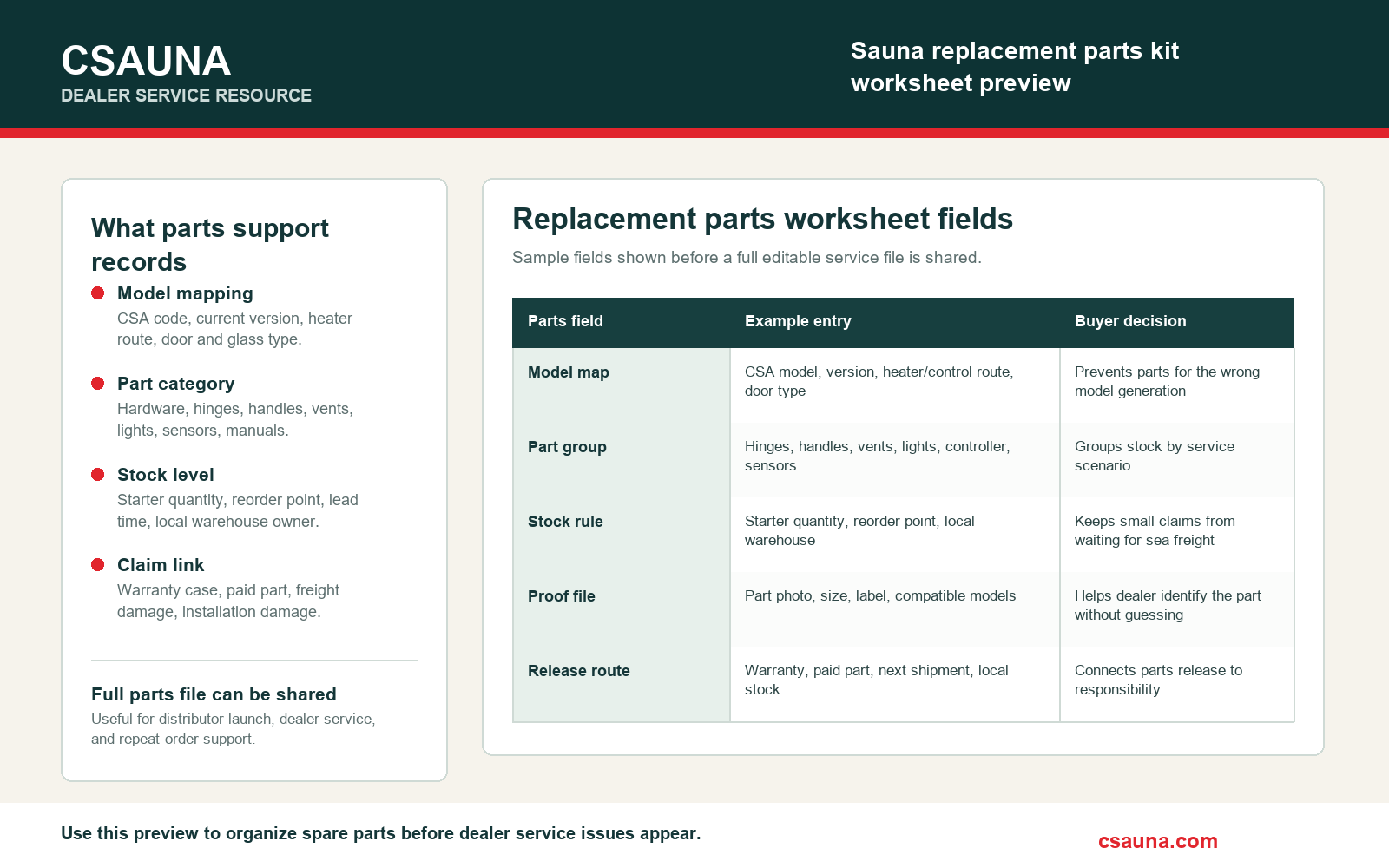
This preview shows the parts fields a distributor can standardize before launch: model mapping, part categories, stock level, identification proof, and warranty or paid replacement route. Use the identification guide for unknown replacement components before a hinge, lamp, controller, seal, or heater part is added to the service file.
- Use it for distributor launch, dealer service, and repeat-order support.
- Attach part photos, size notes, compatible model list, and local stock level when service teams need clarity.
- The complete editable parts file can be shared when the model list and dealer market are known.
No quote request is required for the parts file. It is a buyer-side service stock template.
Sauna replacement parts kit guide for distributors and project buyers
A good parts kit is not a random box of spares. It should match the sauna model, heater voltage, door and glass direction, finish, packing method, and the service promise made to the buyer. Use this guide to build a practical spare-parts file before the order is handed to installation or after-sales teams.
Start with the installed room, not the parts shelf.
For CSauna projects, the parts list is checked against the model code, the approved drawing, the selected wood, the heater and control set, and the packing list. This avoids the common problem where a distributor stocks useful parts but cannot confirm whether a hinge, lamp, control panel, seal, or heater accessory fits the room already sold.
The same logic works for barrel saunas, outdoor cabin saunas, indoor rooms, commercial rooms, infrared rooms, and private-label programs. The exact kit changes, but the control fields stay the same: model, size, electrical standard, exposed climate, glass direction, finish, and warranty scope.
1. Core parts groups to confirm
The list below is the base structure we recommend for importers and distributors. It separates parts that are universal across many models from parts that should be checked against a drawing before purchase.
| Parts group | Typical items | Compatibility check | Service note |
|---|---|---|---|
| Heater and controller | Heater guard, control panel, sensor, relay box, cable set, mounting screws | Voltage, phase, kW range, heater brand, local compliance need | Do not mix EU, North American, and Southeast Asia electrical assumptions without confirmation. |
| Door hardware | Hinges, handle, magnetic catch, roller or sliding track, lock set where used | Door swing, glass thickness, frame material, left or right opening | Mark each door kit by room code to avoid wrong-side installation. |
| Glass and sealing | Silicone seal, glass clip, gasket, edge strip, corner seal, replacement fasteners | Tempered glass thickness, panel size, corner layout, outdoor exposure | Outdoor glass seals should be reviewed with drainage and roof overhang. |
| Lighting | LED strip, lamp cover, transformer, wiring, switch, mounting clips | Voltage, wet-area rating, wood channel location, controller connection | Keep lighting spares separate for indoor room, outdoor room, and infrared models. |
| Bench and backrest | Bench board, support rail, backrest, screw cap, removable panel hardware | Wood species, bench depth, load path, model family | Bench parts should match wood and surface tone, especially for cedar and hemlock rooms. |
| Roof and exterior protection | Shingles, metal flashing, corner trim, drip edge, exterior screws, sealant | Roof type, climate, shipping method, outdoor exposure | Roof spares are more important for dealer programs in wet or snowy markets. |
| Ventilation | Vent cover, sliding vent, mesh, screw pack, air channel trim | Room size, heater location, wall thickness, local installation practice | Keep vent parts tied to the heater position shown in the drawing. |
| Fasteners and labels | Screw packs, washers, plugs, warning labels, rating labels, packing labels | Wood type, installation manual, buyer language, certification note | Small label and screw errors create service tickets out of proportion to their cost. |
| Infrared-specific parts | Panel heater, carbon heater, controller, wiring harness, sensor, cover strip | Cabin model, panel wattage, channel position, safety marking | Infrared parts should not be merged with steam sauna heater parts. |
| Commercial service parts | High-use hinges, bench boards, sensor spares, signage, maintenance logs | Hotel, gym, spa, resort, or project use frequency | Commercial rooms need planned replenishment instead of one-time spare packs. |
2. Compatibility fields that stop wrong shipments
Most parts mistakes happen because a spare part is technically correct but matched to the wrong version of a room. These fields should appear in the parts spreadsheet, warehouse picking sheet, and service record.
| Field | Why it matters | Accepted source | Example check before shipping |
|---|---|---|---|
| Model code | Connects the spare part to the published model page and approved drawing. | Product page, order file, final drawing | Confirm CSA model code and buyer project name match. |
| Room size | Changes bench length, wall boards, glass size, heater power, and packing length. | Approved drawing | Do not reuse a 2-person kit on a 4-person custom room. |
| Wood species | Controls color match, durability expectation, and visible replacement quality. | Material selection sheet | Separate red cedar, thermo hemlock, hemlock, pine, thermo pine, hinoki, Japanese cedar, and rustic cedar. |
| Electrical standard | Protects against wrong heater, controller, transformer, and cable assumptions. | Heater specification and destination market | Record EU, US, and Southeast Asia voltage expectations in the order file. |
| Glass direction | Controls hinge side, handle side, seal profile, and door hardware pack. | Approved drawing or door schedule | Confirm left/right orientation before picking hardware. |
| Roof finish | Changes exterior accessory list for outdoor cabins and barrel saunas. | Material confirmation | Mark shingle color, metal trim, and waterproofing components. |
| Packaging plan | Prevents mixing model spares with general accessories during container loading. | Packing list | Place spare kit label outside the accessory carton and reference the model code. |
| Warranty scope | Separates consumables, installation damage, factory defect, and optional spare packs. | Sales agreement and service policy | Attach photos and batch code before authorizing replacement. |
3. Starter kit structure by buyer type
A hotel project does not need the same spare package as a private-label dealer program. The table below gives a working structure before the final model and order quantity are known.
| Buyer type | Suggested kit focus | What to keep light | Document to attach |
|---|---|---|---|
| Importer | Fasteners, labels, manuals, heater accessories, door hardware, seal profiles | Large custom boards until order mix is fixed | Model matrix and packing list |
| Distributor | Door hardware, controller spares, LED components, seals, roof trim for outdoor models | Rare custom parts with low turnover | Dealer service sheet |
| Dealer showroom | Visible finish samples, hinges, handles, lamp covers, vent covers, small fastener packs | Full heater kits unless qualified staff can install them | Showroom model list |
| Hotel or spa project | High-use parts: hinges, handles, bench boards, sensor, lamp cover, service labels | Parts unrelated to the approved commercial room | Maintenance schedule |
| Builder or installer | Sealant, trim, screw packs, installation labels, vents, glass clips, leveling parts | Electrical components outside licensed installer scope | Installation checklist |
| Private-label program | Logo labels, manual inserts, packaging labels, spare hardware, model-specific accessories | Unbranded paperwork that will not be used by the dealer | Brand handoff file |
4. Stock level method
For a small first order, a simple starter kit is enough. For repeated containers, the parts file should move toward minimum stock levels based on claims, installation frequency, and lead time. The numbers below are planning bands, not a universal rule.
| Part type | Low-volume starter | Distributor repeat order | Commercial program |
|---|---|---|---|
| Door hinges and handles | 1 spare set per model family | 2-5 percent of rooms shipped | Keep site-specific replacements |
| Seal and gasket profiles | One mixed service roll | Separate by glass thickness and door type | Keep enough for planned maintenance cycles |
| LED lighting parts | One controller and strip sample per voltage group | Stock by model family and voltage | Match to project lighting layout |
| Controller and sensor | Only for confirmed heater/control brand | 1-3 percent of rooms shipped | Keep critical spares onsite where downtime is costly |
| Fastener packs | One labeled pack per shipment | Extra packs for dealer installation support | Separate stainless and interior fasteners |
| Bench boards | Usually not needed for samples | Stock only after wood and dimensions repeat | Plan replacement by wear area |
| Labels and manuals | Small spare packet | Keep language and market version separate | Attach to compliance and inspection file |
5. Replacement approval workflow
Replacement requests are easier to solve when the first message includes photos and a model reference. This protects the buyer, the factory, and the service team from guessing.
| Step | Information to collect | Factory check | Output |
|---|---|---|---|
| Identify the room | Model code, order number, project name, installed date | Find the matching product page and order file | Confirmed room record |
| Document the issue | Wide photo, close-up photo, part location, installation environment | Check whether part is damaged, missing, worn, or mismatched | Service reason code |
| Confirm compatibility | Size, wood, voltage, glass direction, heater/control version | Compare against drawing and specification sheet | Correct replacement part |
| Check warranty scope | Usage, installation notes, shipment condition, maintenance history | Separate factory responsibility from consumables and installation damage | Approved path |
| Prepare shipment | Part code, quantity, carton label, destination, preferred courier or container | Check packing method and documents | Replacement packing note |
| Close the file | Received confirmation, installation photo, any repeated issue | Update the model parts file | Improved next-order kit |
Common mistakes to avoid
- Using one generic spare kit for cedar, hemlock, pine, and thermo wood rooms.
- Forgetting voltage and controller differences when the same sauna shape is sold into different markets.
- Shipping door hardware without confirming door swing and glass thickness.
- Mixing project spares with general accessories during container loading.
- Leaving the model code off the spare carton, which makes warehouse handoff difficult later.
What CSauna can prepare
- Model-specific spare-parts table for confirmed sauna rooms.
- Wood and finish notes for visible replacement pieces.
- Heater, voltage, power, controller, and wiring notes by market.
- Packing labels that connect spare cartons to product model codes.
- Dealer-friendly service notes for repeated SKU programs.
6. Editable worksheet fields
The full worksheet should be a spreadsheet rather than a long web page. These are the columns we recommend keeping in the buyer file.
| Column | Purpose | Example entry |
|---|---|---|
| Model code | Connect part to product page and drawing | CSA-026 outdoor cabin sauna |
| Part group | Keep warehouse and service categories clear | Door hardware |
| Part description | Plain-language description for buyer and warehouse | Right-opening glass door hinge set |
| Compatibility fields | Stop wrong-version replacements | 8 mm glass, red cedar frame, outdoor use |
| Electrical standard | Protect heater, controller, and lighting items | 220-240 V EU / 110-120 V US / market confirmed |
| Suggested stock | Separate sample order from repeated program | 2 sets per 100 rooms shipped |
| Evidence needed | Support warranty and service review | Installed photo, close-up, model label, order number |
| Packing note | Make loading and handoff clear | Accessory carton A, label outside, model code on carton |
Need the editable parts worksheet?
Send a short message with the sauna model family, destination market, and whether the parts file is for a sample order, dealer showroom, or commercial project. Our team can prepare the editable spreadsheet version so your warehouse and service team do not have to rebuild the table from the web page.
Model references used in this guide
For parts planning, compare the spare-parts fields against real model pages rather than only a generic sauna category. Useful references include CSA-01 red cedar barrel sauna, CSA-05 commercial cedar sauna room, and CSA-08 black hemlock square sauna.
Related CSauna resources