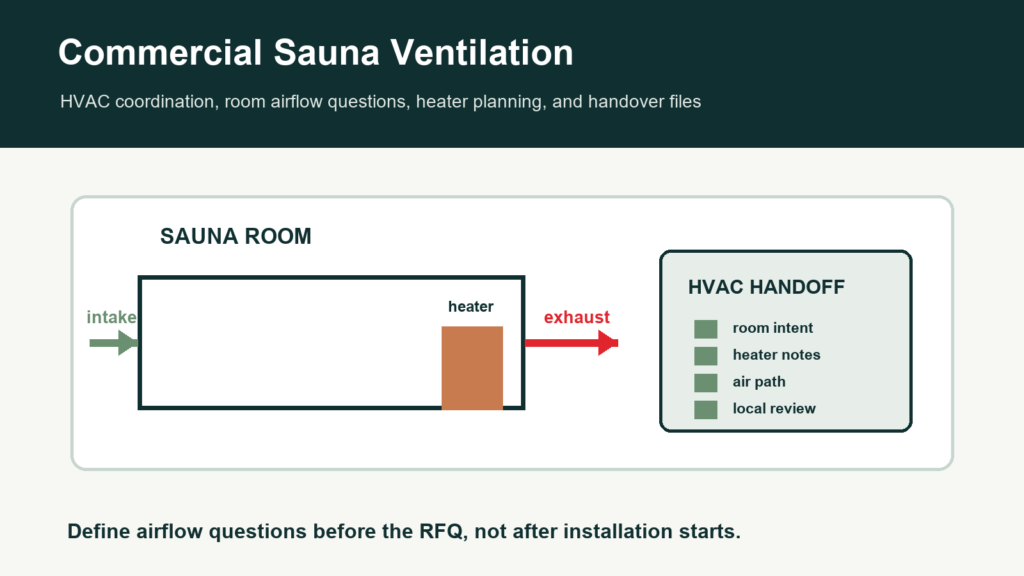
Commercial sauna ventilation and HVAC coordination should begin with the actual project room, selected sauna scope, expected operating pattern, and local design responsibility. A product page can identify the sauna model and the questions to coordinate; it cannot replace a site-specific mechanical design, electrical design, permit review, or commissioning plan.
Prepare a project coordination file
Before discussing equipment or duct routes, collect the selected sauna model reference, internal room dimensions, surrounding room or enclosure details, intended user pattern, site location, applicable project documents, and the design contacts for mechanical, electrical, architectural, and operations coordination. Clearly distinguish the sauna room from changing areas, service spaces, and other adjacent zones.
A useful handoff lists what is already selected and what still needs local confirmation. The local qualified design and installation teams should determine ventilation quantities, air paths, equipment sizing, code obligations, controls integration, fire and moisture strategy, and the approval process for the actual site.
Inputs for the local HVAC and design team
| Coordination area | Information to provide | Why it matters |
|---|---|---|
| Sauna scope | Selected model, internal layout, heater route, glass/door direction, and drawing revision where available. | Provides the project team with the actual room configuration to coordinate. |
| Room and envelope | Finished room dimensions, adjacent rooms, ceiling, wall build-up, glazing, waterproofing, and access constraints. | Room conditions influence the local design review and service access. |
| Use pattern | Private, hotel, spa, gym, or other operation; anticipated occupancy, hours, supervision, cleaning, and recovery expectations. | Commercial operation should be discussed as a project-specific use case. |
| Mechanical/electrical interfaces | Available services, proposed control route, plant-room or equipment location, penetrations, and coordination contacts. | Identifies interface questions before construction decisions are locked. |
| Project documents | Current drawings, site requirements, local code questions, and required submittal or approval process. | Keeps the discussion tied to the responsible local project process. |
Coordinate interfaces before construction
Project teams should record where the sauna connects to the surrounding building systems, who owns each interface, and which drawing or specification controls it. Discuss ventilation openings and routes, equipment access, controls, electrical coordination, moisture management, finishes, drainage where applicable, service clearance, and maintenance access in the context of the actual site.
Do not copy a layout from a different project as a site design. Changes in room geometry, building systems, local requirements, use pattern, and equipment selection can change the proper coordination route.
Use a clear handoff checklist
| Handoff item | Owner to confirm | Record to keep |
|---|---|---|
| Selected sauna configuration | Buyer/project representative and selected product scope. | Model reference, drawing revision, and approved option notes. |
| Site design and system interfaces | Qualified local mechanical, electrical, architectural, and installation teams. | Current project drawings and written interface decisions. |
| Operating and service conditions | Owner/operator with local project team. | Use scenario, cleaning/maintenance route, and access notes. |
| Documents and approvals | Buyer and responsible local parties. | Required submittal list, manuals, labels, and approval status. |
| Open items | Named owner for each unresolved issue. | Question, affected area, needed evidence, and review date. |
Keep decisions traceable through the project
Store the selected product scope, current drawings, interface decisions, local questions, manuals, and final project record together. Update the file when the room, heater route, glass, operating plan, or building-system interface changes. This reduces the risk that construction proceeds from an earlier assumption rather than the currently approved project information.
Keep technical responsibility clear
This guide does not specify ventilation quantities, equipment sizing, duct design, electrical design, structural design, fire strategy, code compliance, permits, or commissioning requirements. These must be determined for the specific site by appropriately qualified local design, installation, and approval parties using the applicable project documents and local requirements.
Use model references consistently
For model references used in a project file, see the sauna product library. For wood, glass, roof, lighting, and accessory directions, see materials and accessory options. Final project design, installation, and approval requirements remain site-specific.
Working file preview: commercial coordination register
Use one coordination register from concept review through handover. It does not prescribe a ventilation solution. It records the specific product selection, room facts, interfaces, responsible parties, drawings, and unresolved questions that the qualified local design and installation team needs to make a site-specific decision.
| Register area | Record for the actual project | Responsible review |
|---|---|---|
| Sauna selection | Selected model/room reference, internal arrangement, drawing revision, visible options, heater/control direction and any changes from the reference image. | Buyer/project owner with factory product-scope review. |
| Site envelope | Finished room dimensions, ceiling, adjacent spaces, openings, access, finishes, waterproofing/drainage questions and maintenance route. | Architect, contractor and responsible local site team. |
| Mechanical interface | Local HVAC design contact, available services, equipment/plant location, penetrations, access, controls interface and coordination drawing reference. | Qualified local mechanical design and installation professionals. |
| Electrical interface | Local electrical design contact, selected electrical route, control location, labels/manual questions, isolation and service access coordination. | Qualified local electrical professionals. |
| Operation | Use type, supervision, cleaning/maintenance access, expected operating pattern, operator contact and handover needs. | Owner/operator with project team. |
| Approval file | Required local submittals, current drawing list, review status, open points, decision owners and revision dates. | Buyer and responsible local approval parties. |
Coordinate the interfaces before the room is closed
Commercial coordination is most useful when every interface has an owner before finishes, ceilings, walls, duct routes, electrical routes, or equipment access are locked in. The buyer should circulate the same current product reference and room plan to the mechanical, electrical, architectural, installation, and operations contacts. When a model, heater route, glass position, bench arrangement, or room geometry changes, log the change and ask the responsible disciplines to review the affected interfaces again.
| Interface to coordinate | Question to record | Evidence to retain |
|---|---|---|
| Room boundary | Which current drawing defines the finished sauna room, adjacent zones, doors, glazing, access and service space? | Dated plan/elevation and drawing revision log. |
| Air path and equipment | Where are the local team’s proposed air paths, equipment locations, access panels and maintenance routes? | Local mechanical coordination drawing and named decision owner. |
| Electrical/control route | Which selected heater/control route is being coordinated, and where are local connection and service questions addressed? | Selected product note, local electrical drawing and open-point record. |
| Moisture and finishes | Who confirms the surrounding envelope, finishes, penetrations, drainage and cleaning implications for the site? | Architectural/site decision and local installation detail. |
| Operations handover | Who receives current manuals, labels where applicable, maintenance access notes and the final project file? | Handover checklist and acknowledged document list. |
Open-point log for the project meeting
Keep each unresolved item short and traceable: identify the room or drawing reference, describe the conflict or missing fact, name the affected interface, assign one owner, and give a review date. Typical open points include an unconfirmed selected configuration, final room dimensions, equipment access, local duct route, electrical/control coordination, penetration details, maintenance access, operating responsibility, document language, or the approval route. Close an item only in the current project record, not in an isolated message.
Use the right handoff sequence
- Freeze the current model or room reference for coordination and label it as a reference until the order file is approved.
- Share the room/site facts and named project contacts with the relevant local disciplines.
- Record interface questions and keep a single current drawing/version list.
- Review any design or product change against mechanical, electrical, architectural, installation and operational implications.
- Before delivery and handover, organize the approved scope, final project documents, available product records, packing/receiving notes and responsible after-sales contacts.
Technical responsibility boundary
CSauna can clarify the selected sauna scope, available materials/components, packing considerations, and available product information for an identified order. This guide does not set ventilation quantities, equipment sizing, duct design, electrical design, structural design, fire or moisture strategy, code compliance, permits, commissioning, or local approval requirements. Those decisions must be made for the actual site by appropriately qualified local design, installation, operational, and approval parties using the applicable project documents and local requirements.