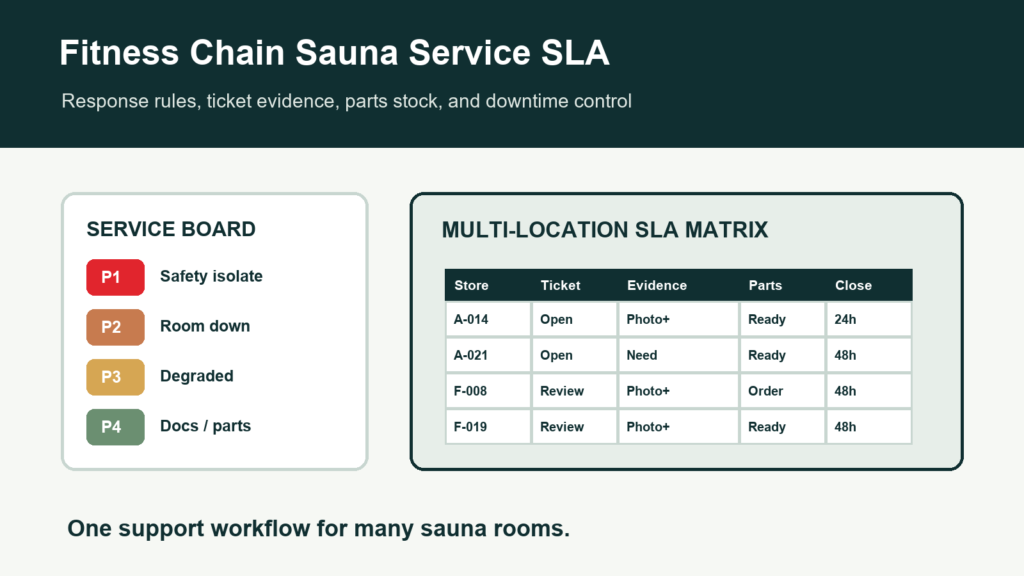
A fitness chain sauna service SLA is the operating agreement behind the sauna room. It defines how support tickets are opened, who owns the first response, what evidence is required, how severity is judged, how spare parts are released, and how downtime is reviewed across many locations.
We wrote this guide for gym chains, franchise systems, recovery studios, wellness clubs, hotel-gym groups, distributors, and contractors preparing a multi-location sauna purchase with us. It is not legal contract advice; final response targets, warranty terms, labor responsibility, freight responsibility, and local service scope must be agreed in the purchase contract or service agreement.
For the editable service and operations worksheet, send CSauna the model family, site type, issue category, service owner, photo evidence, spare-parts need, and closeout status. No quote request is required for the worksheet.
Why SLA Thinking Matters for Fitness Chain Sauna Buyers
One club sauna can be managed informally. Fifty club saunas need a shared process. Without a support SLA, a simple sensor question, glass issue, missing accessory, or cleaning dispute can bounce between club staff, franchise owner, installer, dealer, distributor, and factory contact. The result is slow evidence, unclear responsibility, and unnecessary room downtime.
A practical SLA does not need to overpromise. It should define the evidence and decision path so every location uses the same workflow. That is the difference between a service conversation and a chain-wide operating system.
Severity Levels for Sauna Service Tickets
| Level | Use Case | Expected First Action | Evidence Needed |
|---|---|---|---|
| P1 safety isolate | Safety concern, electrical concern, overheating report, broken glass, or condition requiring the room to be taken out of use. | Stop use, isolate the sauna, record site condition, and route to qualified local professional when electrical or code issues are involved. | Store ID, model, photos, video, installer note, control/heater details, incident record. |
| P2 room down | Sauna cannot operate or a major component prevents normal member use. | Open ticket, collect complete evidence, check local spare parts, and decide repair, replacement, or escalation path. | Ticket form, part photos, error code if any, maintenance log, order and SKU record. |
| P3 degraded operation | Room works but has comfort, fit, finish, control, door, bench, lighting, or accessory issue. | Review evidence, confirm whether it is product, installation, maintenance, or wear related, then schedule part or guidance. | Photos, use history, cleaning record, installation photos, affected part name. |
| P4 documentation or parts request | Manual, drawing, label, spare part, reorder, warranty evidence, or training question. | Route to documentation, warehouse, distributor, or CSauna support contact. | Store list, model/SKU, part quantity, document version, destination market. |
SLA Fields to Define Before Multi-Location Orders
Use the following fields as a buyer-side checklist before signing a pilot or chain rollout order. These are examples of what to define; the commercial terms must be agreed between buyer, supplier, dealer, contractor, and any local service partner.
| SLA Field | What to Agree | Why It Protects Uptime |
|---|---|---|
| Ticket intake owner | Who receives the first ticket: club manager, franchise team, dealer, distributor, contractor, or buyer HQ. | Prevents tickets from starting in the wrong place. |
| Acknowledgement target | How quickly a ticket should be acknowledged by the responsible support owner. | Gives operations a predictable first response. |
| Evidence review target | How quickly complete photos, videos, SKU, model, store ID, and logs are reviewed. | Stops downtime from being caused by missing information. |
| Parts decision rule | When to release local stock, ship from supplier, consolidate with next order, or quote paid parts. | Turns spare parts into a planned support system. |
| Warranty boundary | What is product warranty, freight damage, installation issue, maintenance issue, wear item, or paid service. | Reduces dispute time and inconsistent promises. |
| Escalation path | When a case moves from store to dealer to distributor to CSauna factory contact. | Keeps complex cases visible before they spread across locations. |
| Review cadence | Monthly or quarterly review of tickets, repeated parts, downtime hours, and training gaps. | Feeds service evidence back into procurement and reorders. |
Minimum Ticket Evidence for Chain Locations
A chain buyer should make service evidence simple enough for club staff to collect and complete enough for supplier review. The standard ticket should include:
- Store ID, city, club format, and contact person.
- Sauna model, buyer SKU, CSauna order reference if available, and installation date.
- Severity level, issue description, room status, and whether the sauna is open or closed.
- Photos of the full room, affected part, label or carton mark, control panel, heater area, and installation context.
- Short video when movement, sound, door fit, control behavior, or heater recovery is involved.
- Cleaning log, maintenance record, incident report, or opening-day checklist when relevant.
- Installer or qualified local professional notes for electrical, code, or site-scope questions.
Spare-Parts Stock and Downtime Control
For one location, spare parts can be reactive. For a chain, spare parts should be planned by installed unit count, model family, heater path, climate exposure, member load, and dealer capability. The goal is not to stock everything; the goal is to stock the parts most likely to remove downtime quickly.
| Stock Level | Typical Owner | Examples |
|---|---|---|
| Store-level consumables | Club manager or facilities team. | Cleaning materials, approved signage, small user-facing items. |
| Regional dealer stock | Dealer, distributor, or service partner. | Handles, vents, selected hardware, lamps, seals, stones, approved accessory parts. |
| Distributor reserve | Importer, distributor, or chain HQ. | Model-specific kits, panels, benches, controls, selected heater-related parts subject to compatibility review. |
| Factory support stock | CSauna and buyer planning together. | Project-specific parts, private-label materials, replacement components for planned reorder cycles. |
Use the Spare Parts Minimum Stock Level Guide and Spare Parts Reorder Forecast Guide to turn service history into reorder planning.
Who Owns What in a Multi-Location SLA?
The most important SLA question is responsibility. We can support factory-side documentation, product evidence, packaging data, spare-parts planning, replacement part review, and supplier escalation. The buyer, dealer, installer, contractor, or local service partner normally owns site access, local labor, code compliance, electrical work, user management, and on-site response unless a separate local service arrangement says otherwise.
Put this boundary into the buyer file. Ask who receives tickets, who can authorize parts, who pays local labor, who checks electrical/site issues, who communicates with franchise owners, and who reviews repeated downtime. This keeps the service promise practical instead of vague.
SLA Review Metrics for Chain Buyers
- Installed sauna count by model, location, and opening date.
- Tickets per location and tickets per sauna model.
- Downtime hours by severity level and cause category.
- Evidence-complete rate for first ticket submission.
- Repeated part requests and regional stockouts.
- Warranty, freight, installation, maintenance, and paid-parts split.
- Training gaps found through repeated staff questions.
- Changes needed in buyer file, packing list, manuals, labels, and spare-parts kits.
How to Use This With CSauna
Before a pilot or chain rollout, send us a service brief with buyer type, destination markets, number of locations, target opening schedule, model shortlist, heater path, private-label needs, expected support owner, spare-parts stock plan, and service ticket workflow. We can then help align model scope, documents, packing list, replacement parts, and escalation evidence with the quote.
Read this guide with the Fitness Chain Sauna Procurement Rollout Guide, Gym Sauna Supplier Specification Guide, After-Sales Service SOP, Service Escalation Matrix, Dealer Service Ticket Template, Warranty Evidence and Service Claim Guide, and reference page.
Fitness Chain Sauna Service SLA FAQ
What is a sauna service SLA for a fitness chain?
A sauna service SLA is an agreed support framework for response ownership, evidence collection, severity levels, spare-parts planning, escalation, and closure targets across multiple sauna locations.
Why do fitness chains need sauna SLA language before ordering?
Chains operate many rooms, so unclear service responsibility can create downtime, member complaints, inconsistent dealer responses, and slow parts decisions. SLA language turns support into a defined operating process.
What should be included in a sauna support SLA?
Include severity levels, ticket intake fields, required details, acknowledgement target, review target, parts decision rules, warranty boundary, escalation contact, and monthly or quarterly review rhythm.
Can CSauna guarantee local repair response time?
We can support factory documentation, parts planning, evidence review, and supplier-side escalation, but local repair timing depends on the buyer, dealer, contractor, and market service network agreed in the purchase contract.
Compliance and proof worksheet
Fitness Chain Sauna Service SLA Guide Worksheet
This appendix turns the article into a practical B2B resource. Use it to collect buyer input, attach photos or screenshots, compare supplier replies, and keep an editable worksheet record for the project file.
Buyer input
Collect the exact model, site, document, photo, screenshot, and decision context before sharing the resource with another team.
Supplier or internal reply
Ask for a reply that states what is confirmed, what is missing, and what still needs local or buyer-side review.
Closeout record
Keep the worksheet with the buyer file so the same decision can be reused for future orders, service, training, or project handover.
Buyer working table
Use this table before sending the article to a buyer, dealer, project team, or supplier contact.
| Field | Buyer should record | Supplier or internal owner should confirm | Evidence to attach |
|---|---|---|---|
| Product identity | Record model code, product URL, heater/controller route, target market, and buyer channel. | Confirm which product version the document set belongs to. | Model page, label photo, heater label, and controller screenshot. |
| Document need | Record certificate question, manual language, label, test report, inspection point, and buyer reviewer. | Confirm available documents and which items require local review. | Document folder, reviewer note, and version date. |
| Inspection boundary | Record what the buyer can inspect, what the factory can prove, and what local professionals must approve. | Confirm responsibility boundary before order approval. | Checklist, photos, videos, and signed inspection note. |
Photo, screenshot, and file evidence
Evidence should be named clearly so the same file can support supplier review, buyer education, service follow-up, or project handover.
| Evidence item | What it should show | When to collect it | File name example |
|---|---|---|---|
| Label photo | Product, heater, controller, carton, or compliance label. | When matching documents to a real product. | label-photo-01.jpg |
| Document screenshot | Certificate, manual, wiring reference, test page, or document title/date. | When sharing proof internally. | document-screenshot-02.png |
| Factory or inspection photo | Material, assembly, wiring, packing, or QC check point. | When the buyer needs supplier evidence. | inspection-photo-03.jpg |
| Reviewer note | Buyer compliance comment, electrician note, importer question, or local authority feedback. | Before final approval. | reviewer-note-04.txt |
Reply and closeout table
The reply should help the buyer make a decision, not only repeat that the request has been received.
| Reply area | What the reply should include | Buyer follow-up |
|---|---|---|
| Proof reply | State which documents are available and which product scope they cover. | Avoid using one document to support a different model. |
| Gap reply | List missing evidence, local-review items, and document owner. | Do not promise compliance beyond the evidence. |
| Approval reply | Confirm next step: more photos, document copy, inspection, local professional review, or revised model scope. | Keep a traceable approval path. |
Editable worksheet available
CSauna can share an editable worksheet version for this resource. Send a message with the article name, buyer type, target model or project context, and the fields your team wants to track.
Open the CSauna product catalog Factory profile