Warranty File
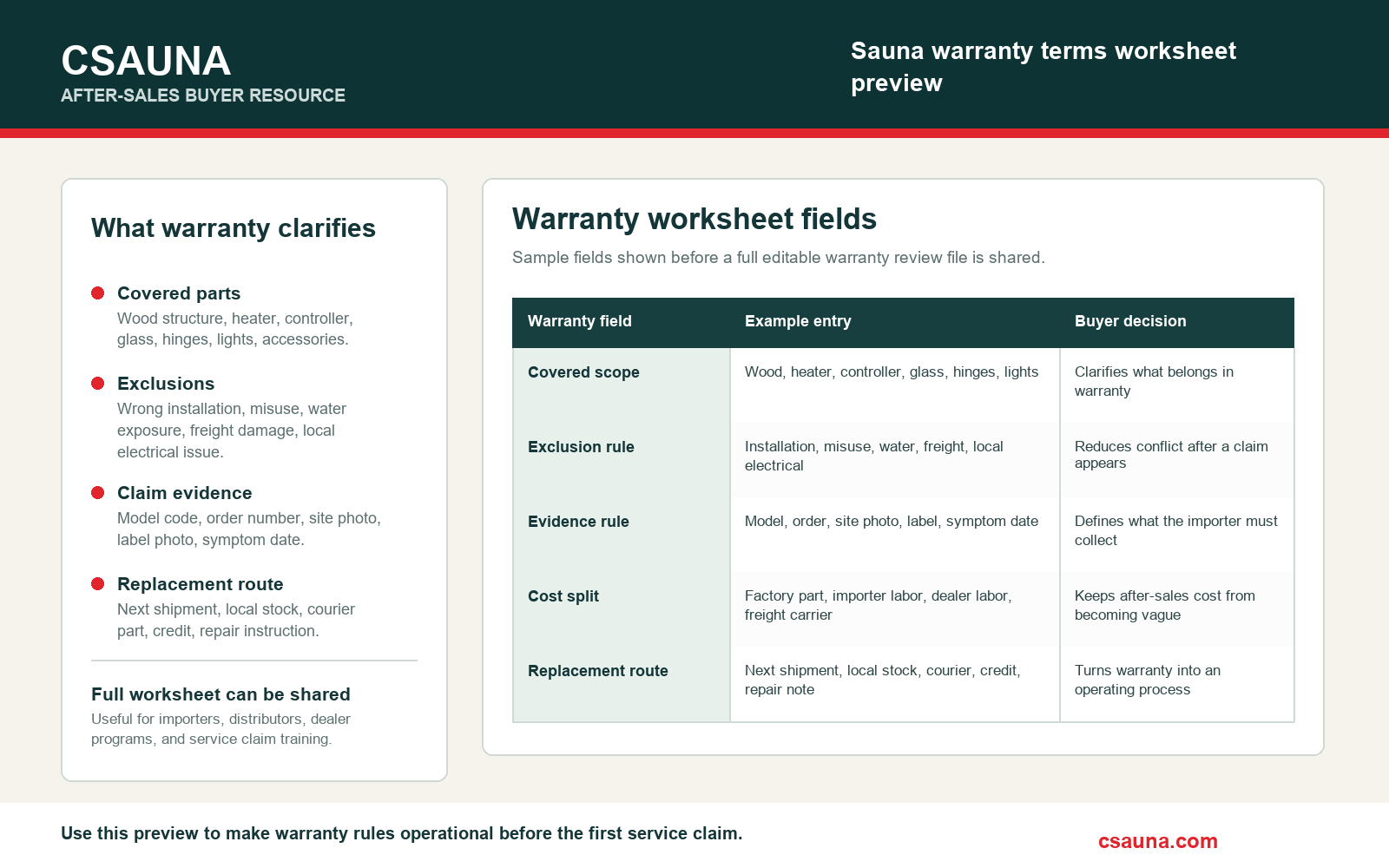
Warranty file preview
Make warranty rules operational before the first claim.
This preview shows the warranty fields an importer or distributor can standardize before a claim appears: covered parts, exclusions, evidence rules, responsibility split, and replacement route.
- Use it for importer warranty files, dealer programs, service training, and claim review.
- Attach model code, order number, site photo, label photo, symptom date, and installation notes when a claim needs review.
- The complete editable warranty worksheet can be shared when the sales channel and warranty owner are known.
No quote request is required for the worksheet. It is a buyer-side after-sales record template.
Sauna warranty terms for importers and distributors
Warranty terms are useful only when they are tied to the model, material, heater, installation record, and service evidence. This guide helps importers and distributors turn warranty language into a practical buyer file.
Separate product warranty from operating issues.
A sauna room includes wood, glass, heater, controller, lighting, roof protection, accessories, packing, and installation conditions. If the warranty file treats every issue the same way, both buyer and factory lose time.
The practical approach is to define what is covered, what needs evidence, which parts are consumables, and how the service record should be kept for repeated dealer or commercial programs.
1. Warranty scope categories
Define the warranty scope by part group instead of using one vague sentence for the whole sauna.
| Scope | Typical items | Evidence needed | Decision note |
|---|---|---|---|
| Structural room | Wall panels, bench supports, door frame, roof structure | Model code, installed photos, issue photos, site condition | Separate production issue from site movement or misuse |
| Wood surface | Visible boards, bench, backrest, exterior trim | Wood species, cleaning method, humidity or outdoor exposure photos | Natural wood movement and severe damage need different handling |
| Heater and controls | Heater body, controller, sensor, wiring accessories supplied by factory | Voltage, installation note, error code, qualified electrician check | Local wiring must be reviewed before replacement |
| Glass and door hardware | Tempered glass, hinges, handle, seals, clips | Door direction, close-up photo, installation condition | Transit damage, installation adjustment, and product issue must be separated |
| Lighting and accessories | LED parts, lamp cover, bucket, ladle, timer, signs | Accessory list and photo | Some items are consumable or shipment-shortage items |
| Packing and shipment | Carton damage, missing pieces, loading marks | Photos before unpacking, carton label, packing list | Claims are strongest before cartons are discarded |
2. Claim intake checklist
The first message should contain enough facts for the factory to identify the room and the part.
| Field | Why it matters | Good example | Weak example |
|---|---|---|---|
| Model and order reference | Connects the claim to drawings and packing list | CSA-05, hotel project, order date | The big sauna room |
| Installed photos | Shows site and installation context | Wide room photo and close-up | Only a cropped damaged part |
| Part location | Helps identify replacement version | Right door hinge, upper position | Door part is broken |
| Use history | Shows whether issue appeared during shipment, installation, or operation | Installed two weeks ago, daily hotel use | It stopped working |
| Electrical information | Needed for heater, controller, lighting | 220-240 V, controller model, error code photo | Power has a problem |
| Requested action | Clarifies whether buyer needs part, advice, or record review | Confirm replacement hinge set | Please solve quickly |
3. Parts that need clearer limits
Some parts create disputes if limits are not written early. Define these before the first container is shipped.
| Part group | Limit to define | Why buyers ask | How to reduce dispute |
|---|---|---|---|
| Wood color | Natural tone variation and weathering | Visible boards do not look identical | Confirm species, grade, finish, and photo standard |
| Heater stones | Breakage, dust, and replacement cycle | Heating seems slower | Record stone handling and maintenance method |
| Glass | Transit damage versus installation damage | Crack found after unpacking | Require carton and unpacking photos |
| LED and lamps | Voltage, moisture, service access | Light does not switch on | Confirm transformer and wiring responsibility |
| Accessories | Included items versus optional kit | Buyer expected more accessories | Attach accessory list to invoice and packing file |
| Labels and manuals | Private-label language and version | Wrong language or missing brand mark | Approve artwork before packing |
4. Warranty decision workflow
Use a simple decision path so service teams do not improvise.
| Step | Action | Owner | Output |
|---|---|---|---|
| Identify | Match model, order, and installed room | Dealer or importer | Confirmed room file |
| Document | Collect wide and close-up photos with part location | Buyer or operator | Evidence folder |
| Classify | Product, transit, installation, operation, consumable, or unclear | Importer and factory | Claim category |
| Confirm part | Check compatibility before sending replacement | Factory support | Correct part version |
| Ship or advise | Send part, repair instruction, or maintenance guidance | Factory/dealer | Resolution note |
| Close | Attach final photo and update service history | Dealer or buyer | Closed case record |
How buyers should use this document
The document should sit inside the buyer file rather than live only as a web article. Each buyer role uses it differently, so the working sheet should name the owner, the decision date, and the next action. This makes the resource practical for procurement, dealer training, project installation, and future service review.
| Buyer role | Use this document for | Fields to keep visible | Next action |
|---|---|---|---|
| Importer | Compare supplier readiness beyond first unit price | Model, material, voltage, documents, packing, spare parts | Attach to supplier comparison file |
| Distributor | Build a repeatable dealer or SKU program | Model family, stock plan, service process, training owner | Turn into internal operating sheet |
| Dealer | Explain models consistently and avoid wrong promises | Product page, drawing, accessories, warranty and installation notes | Use during customer handover |
| Commercial buyer | Coordinate hotel, gym, spa, or resort stakeholders | Approved drawing, site owner, maintenance owner, evidence record | Attach to project folder |
| Installer | Check site, access, power, and final room condition | Dimensions, door direction, heater notes, installed photos | Complete handover record |
| Service team | Resolve future questions with dated evidence | Claim photos, part codes, installed model, previous action | Update case history |
Review cadence after the first order
A resource file becomes stronger after the first order ships, installs, and produces real feedback. The buyer should review what was clear, what was missing, and what caused extra messages. That review helps the next container, project, or dealer rollout become simpler.
| Timing | What to review | Evidence to check | Decision to make |
|---|---|---|---|
| Before production | Confirm all model, material, heater, and document decisions | Approved drawing and option sheet | Lock or revise the file |
| Before shipment | Check cartons, labels, accessories, spare parts, and manuals | Packing list and photos | Approve loading and documents |
| After arrival | Record damage, missing items, or installation questions | Carton photos and receiving notes | Separate logistics from product issues |
| After installation | Check function, site fit, and buyer handover | Installed photos and test notes | Update installation guidance |
| After first month | Review service questions and staff feedback | Issue log and maintenance notes | Update training or spare parts |
| Before repeat order | Remove slow-moving items and strengthen weak fields | Sales, warranty, and warehouse records | Revise next-order file |
Evidence to keep in the buyer file
A good B2B resource page should improve the buyer file. Keep the approved facts where the factory, buyer, warehouse, installer, and service team can all see them later.
The most useful files include the model page, approved drawing, material record, heater and voltage notes, packing list, installed photos, and any service or change history. This reduces arguments months after delivery because the answer is connected to a dated file.
| Evidence item | What it proves | Who uses it | When to update |
|---|---|---|---|
| Model page | The visual model and public reference selected by the buyer | Buyer, dealer, factory sales | When the model family changes |
| Approved drawing | Size, door, glass, bench, heater, ventilation, and accessory position | Design, installer, project owner | Whenever layout changes |
| Material record | Wood species, roof, exterior finish, hardware tone, and certificate needs | Buyer and design team | Before production material is cut |
| Electrical note | Voltage, phase, heater power, controller position, and market standard | Importer and electrician | Before heater package is locked |
| Packing file | Carton order, accessory carton, spare-parts carton, labels, manuals, and loading notes | Warehouse and buyer | Before shipment |
| Installed or handover photos | What was actually delivered and installed | Dealer, service team, facility manager | At installation and after service work |
Useful warranty language
- Specific part groups
- Evidence required before replacement
- Clear consumable list
- Installation responsibility
- Market-specific electrical notes
Avoid vague promises
- Lifetime wording without limits
- No photo requirement
- No model code
- No distinction between shipment and installation
- No spare-parts compatibility check
Model references used in this guide
For dealer and distributor work, compare the file against real model references such as CSA-01 red cedar barrel sauna, CSA-02 outdoor cube cedar sauna, and CSA-10 backyard sauna cabin.
Factory note
For repeat orders, the strongest buyer files are the ones that stay close to the actual room being produced. Keep the model code, final drawing, material decision, heater package, packing notes, and service evidence together. That makes future quotation, production, installation, and replacement-parts work faster and less dependent on memory.
Need an editable warranty claim sheet?
Send the model family, buyer type, and market. We can prepare an editable warranty intake sheet for importer, dealer, or commercial operator files.