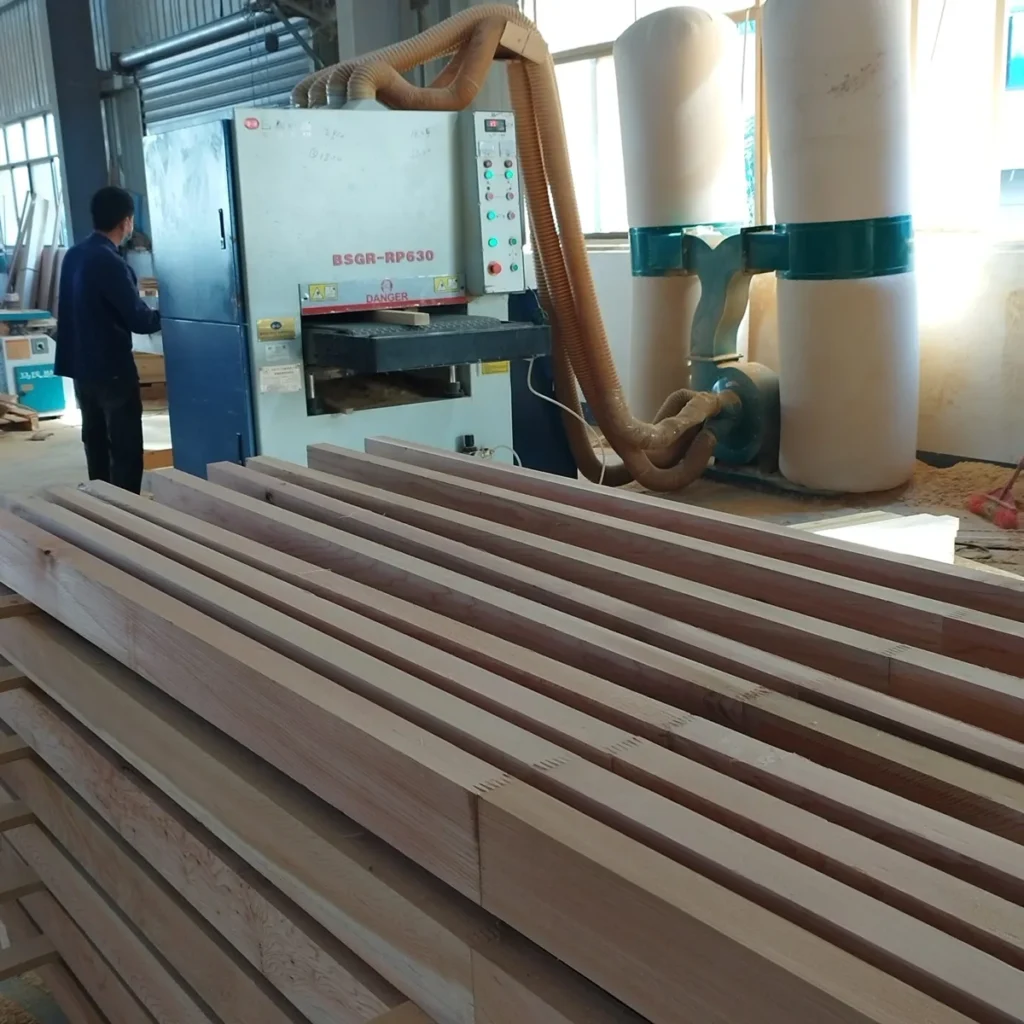
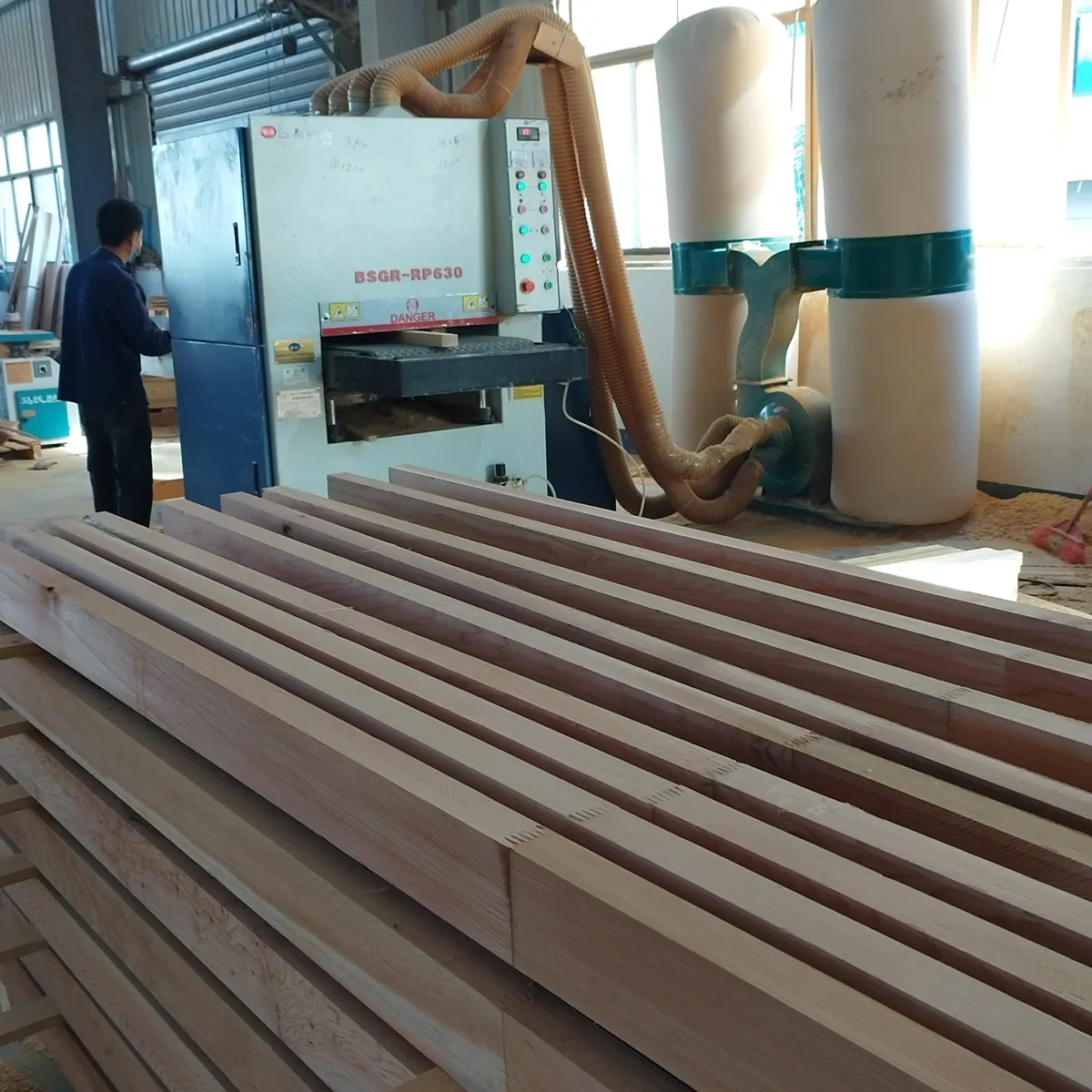
Moisture control worksheet
Wood moisture reading and action table
Moisture control is not only a factory drying topic. Importers and distributors need a receiving method, storage rule, and escalation path when timber readings do not match the market or installation environment.
| Checkpoint | What to measure | Acceptable signal | Action if abnormal |
|---|---|---|---|
| Factory pre-pack check | Moisture readings from wall boards, bench boards, door frame, floor parts, and replacement strips before packing. | Readings are consistent by timber batch, with no obvious wet boards mixed into dry boards. | Hold packing, separate the batch, request new readings, and add photos of meter position to the buyer file. |
| Arrival receiving | Random checks from at least three cartons or crates, including thick boards and any parts near visible moisture marks. | No condensation, no mildew odor, no swollen carton, and readings close to the expected range for the product type. | Quarantine affected cartons, photograph carton marks, record meter readings, and avoid immediate installation. |
| Warehouse storage | Room humidity, floor contact, pallet condition, wrap condition, ventilation, and distance from doors or wet walls. | Packages stay dry, off the floor, and away from sudden humidity changes. | Move stock, improve ventilation, add pallet protection, and recheck readings before dealer delivery. |
| Before installation | Door fit, bench board flatness, panel gaps, screw area, and any board with visible movement. | Parts acclimate to the site and do not show new warping, cracking, or sticky coating. | Pause installation, document the affected part, confirm site humidity, and decide replacement or local rework. |
| Complaint review | Installation date, climate, usage hours, ventilation habit, heater route, cleaning method, and photos over time. | The issue can be linked to production, storage, installation, or use instead of guessing. | Build a case file with readings, photos, timeline, and part numbers before assigning responsibility. |
For the editable wood moisture worksheet, send CSauna the product family, wood species, destination climate, warehouse condition, and sample meter photos. No quote request is required for the worksheet.
Why Sauna Wood Moisture Content Matters (And How to Check It)
Introduction
Wood is a living material. Even after it’s been milled into lumber and built into a sauna, it continues to exchange moisture with its environment — absorbing water from humid air, releasing it when the air is dry, expanding and contracting with every temperature cycle. This behavior isn’t just academic trivia. In a sauna, where the air swings from cool and damp to hot and dry in the space of an hour, the moisture content of the wood determines whether your sauna ages gracefully or develops cracks, gaps, and structural problems within a few seasons. Most buyers don’t think about sauna wood moisture content until a door won’t close properly, a stave has cracked, or the benches feel rough despite careful maintenance. By then, the problem has usually been developing for months. This guide explains what moisture content means, why it matters so much in the sauna environment, how factories are supposed to manage it, and how to check it yourself when the sauna arrives.Ideal Moisture Content Range for Sauna Timber
The ideal moisture content for sauna wood at the time of manufacture depends on where the sauna will be used. For saunas installed in temperate inland climates (most of Europe, much of North America), the target moisture content at delivery is 8–12% for the interior wood. This is the range at which wood is dimensionally stable in typical indoor or sheltered outdoor conditions. At this moisture content, the wood will absorb some moisture in humid conditions and release it when heated, with movements small enough not to cause joint failures or visible gaps. For saunas in humid coastal climates, a slightly higher moisture content at delivery — 10–14% — is sometimes acceptable, because the wood is already closer to equilibrium with the ambient humidity. However, the performance during use — the rapid drying cycle when the sauna heats — should still fall within acceptable ranges. For saunas in very dry climates (heated indoor environments, dry continental winters), the risk is the other direction: wood that arrives at 12% may drop to 5–6% in a heated room during winter, becoming brittle and prone to cracking. Factory-finished saunas with a proper surface treatment help slow moisture exchange enough to mitigate this. barrel sauna maintenance The absolute range that manufacturers specify: 6–14% is generally acceptable for interior sauna wood. Below 6%, wood becomes overly dry and prone to surface checking. Above 14%, wood is too wet — it will shrink noticeably as it dries in use, potentially opening joints and causing structural issues.What Happens if Wood Is Too Wet or Too Dry
Wood That Is Too Wet
The problems with wet wood don’t always show up immediately. Wood with high moisture content at delivery will continue to dry after installation — slowly in a sealed sauna, faster if the sauna is heated frequently without protective surface treatment. Visible symptoms: Stave or panel shrinkage as the wood dries. Gaps appearing between staves in barrel saunas. Doors that no longer close flush. Bench surfaces developing minor gaps between boards. Structural consequences: In barrel saunas, wet staves that shrink can loosen the stave joint system. The barrel depends on the mechanical fit of the staves — the slight taper and the steel bands that compress the barrel — to maintain water-tightness. If staves shrink below the tolerance the barrel was designed for, the bands may no longer hold the staves tight enough, and the barrel can develop persistent leaks. Mold and odor: Wet wood in a warm environment is an ideal growth medium for mold. You may notice a musty smell during the first few uses of a sauna built with wood that was too wet at manufacture. The smell typically dissipates after several heating cycles but can recur if the wood hasn’t been properly surface-treated. Long-term durability: Wet wood that goes through repeated wet-dry cycles ages faster than wood that started at appropriate moisture content. The repeated swelling and shrinking stresses the wood cell structure, leading to earlier surface checking, splinters, and reduced lifespan.Wood That Is Too Dry
Overly dry wood is less common than wet wood in imported saunas, but it occurs in saunas that have been stored in very dry conditions for extended periods — particularly in climate-controlled showrooms or warehouses during winter. Visible symptoms: Surface checking (small cracks on the surface of the wood, following the grain). In severe cases, audible creaking or popping as the wood adjusts to moisture absorption during the first few sauna sessions. Structural consequences: Overly dry wood is more brittle and less able to absorb impact without damage. It also absorbs moisture more aggressively when exposed to humid conditions, which can cause more pronounced swelling than normal. This isn’t usually a structural risk in a sauna — the swelling is typically absorbed by the joint tolerances — but it can cause temporary fitting issues (tight doors, stiff hinges) until equilibrium is reached. Not the primary concern: Dry wood is generally preferable to wet wood for saunas. The problems caused by dry wood are usually cosmetic and self-correcting once the sauna is used regularly. Wet wood is the more serious issue.How Factories Should Kiln-Dry Timber
Proper kiln drying is the single most important process step that determines the moisture content of the finished product. A factory that doesn’t kiln-dry properly will always produce saunas with moisture problems, regardless of how good the joinery is. Air drying alone is not sufficient. Even in a dry climate, air-drying lumber to 8–12% moisture content takes 12–18 months for thick material like stave stock. Most factories don’t hold inventory that long. Air-dried lumber at 15–18% moisture content is not suitable for immediate use in a sauna. Commercial kiln drying brings lumber to target moisture content in days rather than months. The kiln operator sets a schedule based on the species, thickness, and target moisture content. For sauna timber, the target is typically 8–10% for interior applications. The kiln must be properly operated: rushing the process (too high temperature, too fast a schedule) can cause internal checking and casehardening — a condition where the surface is over-dried while the core remains wet, causing problems when the wood is machined. Post-kiln conditioning is a critical step that many budget factories skip. After kiln drying, the wood is held in a climate-controlled space at moderate humidity for a period (typically 2–4 weeks) to equalize the moisture content throughout each piece. Without conditioning, you get a stack where some boards are at 7% and adjacent boards are at 13% — a recipe for uneven movement after installation. Ask your factory about their drying process. A credible factory will be able to tell you: what species they use, what the target moisture content is, what drying method they use (kiln type, schedule), and what the post-drying conditioning process is. If the answer is vague or references “air-dried” for the primary structural timber, that’s a red flag.How to Test Moisture Content on Arrival
Testing the moisture content of your sauna wood on arrival is straightforward and takes about 10 minutes with the right tool: a pin-type or pinless moisture meter. Choosing a moisture meter: A pin-type meter drives two pins into the wood surface and measures the electrical resistance between them. It’s accurate and works on any wood species. The downside: it leaves small pinholes. A pinless (capacitance) meter reads moisture through the surface without leaving holes, but readings can be affected by wood species and surface irregularities. Either type works for sauna inspection. Pin-type meters are more affordable and widely available. How to measure: At 3–5 points across each major component — staves for barrel saunas, wall panels for cabin saunas, bench boards. Don’t measure at the very end grain of boards, where readings are artificially high. Measure on the flat surface of the board, away from knots and resin pockets. Expected readings: Interior wood should read between 8% and 12% if the kiln drying was done properly. Readings above 14% are a concern. Readings above 18% indicate seriously wet wood and warrant a conversation with the factory. Measure the floor panels and lower staves first — these are the most likely to have absorbed moisture during shipping if the packaging was compromised. The upper sections of the sauna typically dry faster and are usually at lower moisture content.Red Flags When Inspecting Sauna Wood
Signs the Wood Wasn’t Dried Properly
- Visible gaps between staves in a new barrel sauna that wasn’t exposed to significant moisture during shipping. A new barrel should be tight. Small gaps are acceptable; gaps wider than 2–3mm in a new unit are not.
- Discolored or darkened wood on the end grain of panels or staves. This can indicate that the wood was stored wet before or after kiln drying.
- Mold or mildew on any surface, including the interior. Clean it off and check the moisture content of the affected area. If it’s above 16%, investigate further.
- A musty smell when you open the sauna packaging that doesn’t dissipate after the first few heating sessions.
- Very light-colored, almost white wood that absorbs water immediately when you drip water on it — this indicates the wood was very dry and may have been over-dried, or it may simply be a very low-density species that soaks up moisture readily.
When to File a Claim
If moisture content readings on arrival are consistently above 16% across multiple components, or if you see mold on interior surfaces, document everything with photos and contact your supplier immediately. The supplier should be given the opportunity to remedy the situation — either a partial credit, a replacement of affected components, or guidance on how to dry the wood before assembly. Do not assemble a sauna with wood that is above 16% moisture content. The assembly process itself stresses the joints, and the shrinkage that will occur as the wood dries will be amplified by the assembly. Better to identify the problem before you invest hours of labor in assembly.Wood moisture and storage decision table
Moisture content decisions should connect wood condition, packing, destination climate, and buyer storage plan before production is released.
| Decision point | Buyer question | Supplier evidence to request | buyer file field to confirm | Risk if missing |
|---|---|---|---|---|
| Wood species and use | Is the selected wood suitable for indoor, outdoor, or commercial use? | Wood species note, visible material photos, and intended application notes. | Wood species, product type, indoor/outdoor use, finish plan. | Buyer compares moisture numbers without checking whether the wood choice fits the use case. |
| Drying and inspection | How is moisture checked before packing? | Moisture check photo or record, batch note, and inspection timing. | Required inspection point, acceptable range, reporting format. | Swelling, cracking, or fit problems appear after shipment. |
| Packing timing | How long will finished wood wait before loading? | Production schedule, packing date, loading date, and storage condition note. | Expected lead time, warehouse storage, container timing. | Wood condition changes between inspection and loading. |
| Destination climate | Will the sauna be stored or installed in a dry, cold, humid, or coastal market? | Handling notes and acclimation advice for the destination market. | Destination country, climate, site storage, installation timing. | Installer treats normal wood movement as a product defect. |
Conclusion
Sauna wood moisture content is one of those factors that’s invisible until it becomes a problem — and then it costs money and time to fix. The good news: it’s easy to check, and reputable factories will stand behind their product if the moisture content is genuinely out of specification. The practical steps for any buyer: get a moisture meter, use it on arrival, before assembly. Document the readings. If something looks wrong, stop and call the factory before you build. These 10 minutes of checking could save you 20 hours of rework. CSauna kiln-dries all structural timber to 8–10% moisture content before assembly, with post-drying conditioning of a minimum of two weeks. Every shipment includes moisture content readings from our quality control log. If you have questions about the moisture content of a current or planned order, we’re happy to walk you through our process. *Ready to source premium saunas factory-direct? [Contact CSauna](/contact) for a free quote.* quality inspection Indoor Sauna product pageMaterial evidence worksheet
Wood Moisture Content Inspection Worksheet
Wood moisture content is not a single number on a brochure. Buyers should record species, storage condition, moisture readings, photos, packaging condition, and climate risk before accepting a material explanation.
Species selection and moisture records should be reviewed together. The CSauna materials library lists the wood options, origin notes, and supporting documents available for specification review.
Incoming check
Photograph the wood surface, package condition, label, and storage environment before installation or showroom assembly.
Reading record
Keep moisture meter photos or screenshots with location, date, and measurement point.
Climate context
Separate factory moisture, shipping condition, warehouse storage, and site humidity before making a claim.
Moisture reading log
Use a consistent reading log if a dealer, contractor, or buyer questions wood movement, cracking, swelling, or finish condition.
| Measurement field | What to record | Photo or screenshot needed | Review note |
|---|---|---|---|
| Model and batch | Model code, order, wood species, panel or part location. | Product label, carton label, or order screenshot. | Connects the reading to the correct project. |
| Reading point | Wall panel, bench board, door frame, roof board, trim, or crate wood. | Close-up photo with measurement point marked. | Avoid mixing readings from different parts. |
| Meter reading | Moisture percentage, meter type, calibration if available, and date. | Photo of meter on the actual wood point. | One reading is not enough for a claim. |
| Storage condition | Warehouse, outdoor covered area, heated showroom, container, or installed site. | Wide photo of storage area. | Site storage can change moisture after delivery. |
| Visible condition | Crack, warp, swelling, gap, stain, mold concern, or normal grain variation. | Wide photo plus close-up. | Record whether the issue is cosmetic, structural, or fit-related. |
Buyer evidence checklist
The evidence below helps a supplier decide whether the issue belongs to material selection, shipping, storage, installation, or normal wood behavior.
| Evidence | Why it is useful | Minimum detail |
|---|---|---|
| Wide product photo | Shows whether the issue affects one board, one wall, or the whole sauna. | Include room, heater side, door side, and bench side. |
| Close-up with scale | Shows the size of a crack, gap, or swelling line. | Use a ruler or known reference if possible. |
| Package condition | Shows whether moisture or impact may have happened during transport. | Keep carton, pallet, or crate photos before disposal. |
| Climate note | Explains dry, humid, coastal, cold, or hot site conditions. | Record season and whether HVAC or outdoor exposure is involved. |
| Cleaning or treatment note | Shows whether water, detergent, oil, or sealant changed the surface. | Record product used and date. |
Supplier reply table
A professional supplier reply should separate normal wood variation from a production or shipping issue.
| Reply topic | Supplier should confirm | Buyer should decide |
|---|---|---|
| Species and grade | Wood species, expected color variation, knots, and surface behavior. | Whether the appearance matches the selected grade. |
| Moisture range | Expected moisture range at production and how shipping/storage can change it. | Whether additional readings are needed. |
| Installation effect | Whether base, ventilation, heater heat, or door alignment may affect movement. | Whether an installer needs to inspect the site. |
| Remedy route | Care instruction, replacement part, finish advice, or warranty review. | Whether the issue is service, cosmetic, or claim-related. |
Editable worksheet available
CSauna can share an editable wood moisture inspection worksheet. Send a message with the wood species, model code, project climate, storage condition, and whether you need a dealer, contractor, or buyer handover version.