A local repair or adjustment can sometimes resolve a documented service issue more quickly than waiting for a replacement shipment. It should still be handled as a controlled case, not as an open-ended promise. Before work begins, identify the actual model, issue, site condition, proposed scope, evidence, decision owner, and the record required to close the case.
Open one service record for each issue
Start with a dated service record rather than an informal message. Record the model reference, order or buyer reference where available, site contact, symptom, date observed, photos or video, and the person responsible for the next decision. If a part is involved, identify the part and product revision before assuming compatibility.
Separate the issue from the proposed work
The reported symptom does not by itself prove a product issue or determine the repair route. Review product condition, installation context, site access, local services, previous work, and the evidence available. Define the proposed action separately: inspection, minor adjustment, part replacement, a limited repair, or a request for further diagnosis.
| Before any approval | Record to collect | Purpose |
|---|---|---|
| Product identification | Model reference, order reference where available, photos of the affected area, and the relevant revision or part information. | Prevents a repair decision from being based on a similar-looking but different product. |
| Issue evidence | Date, symptom description, wide and close photos, short video when useful, and any prior service history. | Lets the responsible parties review the actual condition rather than a summary alone. |
| Site context | Installation status, access, local services, foundation or surrounding conditions, and local technician observations. | Separates product questions from site or installation conditions. |
| Proposed scope | Specific action, parts if any, expected time, named technician, and work that is explicitly excluded. | Keeps a limited approval from becoming an undefined site visit. |
| Decision record | Named decision owner, date, allowed amount or hours if approved, currency, and closeout requirements. | Creates a traceable service and finance record. |
Approve only a defined, documented scope
If local work is considered, record exactly what is approved and what is not. A small inspection or adjustment is different from structural work, electrical work, glass work, or a wider installation correction. Do not convert a preliminary discussion into an approval without a clear scope, evidence requirement, and responsible owner.
Keep local technical responsibility clear
Electrical work, controls, heater service, structural changes, glass work, site correction, code compliance, permits, and safety decisions must be assessed and performed by appropriately qualified local parties under the applicable local requirements. This guide does not authorize unqualified work or determine whether an issue is covered by a particular warranty, contract, or local obligation.
Close the case with the same level of evidence
| Closeout item | What to retain | Why it matters |
|---|---|---|
| Approved scope | Written decision, date, named owner, and any agreed limit or exclusion. | Confirms what the service team was asked to do. |
| Work record | Technician note, parts used, time record, and any unresolved condition. | Creates a usable service history for a later review. |
| Before-and-after evidence | Relevant photos or video, taken with the same issue in view where practical. | Shows the condition reviewed and the result of the action. |
| Buyer/site acknowledgement | Completion, remaining issue, or agreed next step from the buyer or site contact. | Prevents an unclear handover after work is finished. |
| Case learning | Any recurring installation, packing, parts, manual, or training question. | Allows the team to improve documents and future service preparation. |
Review patterns rather than isolated invoices
Repeated service records can reveal a product, documentation, packaging, parts-identification, training, or site-handover question. Review the actual evidence and model references before deciding whether a pattern exists. Keep finance treatment separate from the technical case record so a credit, invoice, or future order discussion is not mistaken for a technical conclusion.
Prepare a usable service request
A useful request includes the model reference, affected location, destination, issue description, photos or video, installation status, proposed action if known, and the party responsible for local technical work. The product library can help identify the model reference; final service scope and commercial treatment remain case-specific.
Working file preview: replacement labor review
Use a replacement labor review before assigning work, quoting an allowance, or making a customer promise. The file should identify the exact product, observed condition, evidence, local work scope, and the party that can approve the next action. It does not establish warranty coverage, a fixed labor rate, safety approval, or responsibility for local installation work.
| Review field | What to record | Why it is needed |
|---|---|---|
| Case identity | Order/project reference, model code, site, delivery or installation date, dealer contact, and customer contact route. | Prevents a labor request from being separated from the actual configuration. |
| Observed condition | Factual description, affected area or part label, operating context, date found, and any restriction already applied. | Keeps observation distinct from a conclusion about cause. |
| Evidence set | Wide and close photos, video where relevant, current drawing/configuration, manuals, labels, prior service notes, and installation record. | Lets the responsible reviewer understand the case before work is assigned. |
| Proposed local scope | Tasks, access conditions, qualified trade requirement where applicable, estimated visit sequence, and materials/tools not included. | Makes the request reviewable without presenting it as an approved scope. |
| Commercial question | What approval or clarification is requested: parts, labor review, site visit, documentation, or another commercial decision. | Gives the reviewer a specific decision to make. |
| Approval record | Named approver, approved scope, limits, agreed evidence, date, and any work that remains excluded. | Creates a traceable case-specific approval. |
Separate work scope from approval
A dealer can describe the work believed necessary, but it should not be treated as approved until the responsible parties have reviewed the evidence and scope. Electrical, structural, glass, heater, ventilation, installation, and safety-related work may require qualified local professionals and site-specific procedures. Record those requirements as conditions, not as generic labor-line items.
Useful evidence before a review
- Exact model reference and the selected configuration or drawing revision.
- Part, carton, controller, or product labels that identify the affected item.
- Wide context and close photographs taken safely before alteration where possible.
- Delivery, installation, commissioning, maintenance, and earlier service records relevant to the condition.
- A short timeline of what occurred, what the site did, and what changed after that action.
- The proposed local work sequence, access restrictions, and named local contractor where applicable.
- The specific commercial decision needed, rather than a general request to “cover labor.”
Case review and closeout
| Stage | Dealer action | Closeout record |
|---|---|---|
| Collect | Assemble the factual timeline, model, labels, evidence, configuration, and site information. | Complete evidence list with missing items noted. |
| Clarify | State the proposed scope and the exact approval, part, or technical question required. | Written question assigned to a named owner. |
| Review | Keep local technical and site-safety decisions with the responsible qualified parties. | Review notes, conditions, exclusions, and next action. |
| Authorize | Do not schedule or promise work beyond the documented case-specific approval. | Approved scope, date, limit, and responsible contact. |
| Complete | Record what was done, evidence of completion, remaining restriction, and customer communication. | Dated closeout linked to the service and order files. |
Keep each request attached to its order and service record. Labor, parts, commercial treatment, local rates, site access, and technical requirements vary by case. Final responsibility and approval remain case-specific approval decisions made by the responsible commercial, site, and qualified local parties.
Download the editable dealer service case record
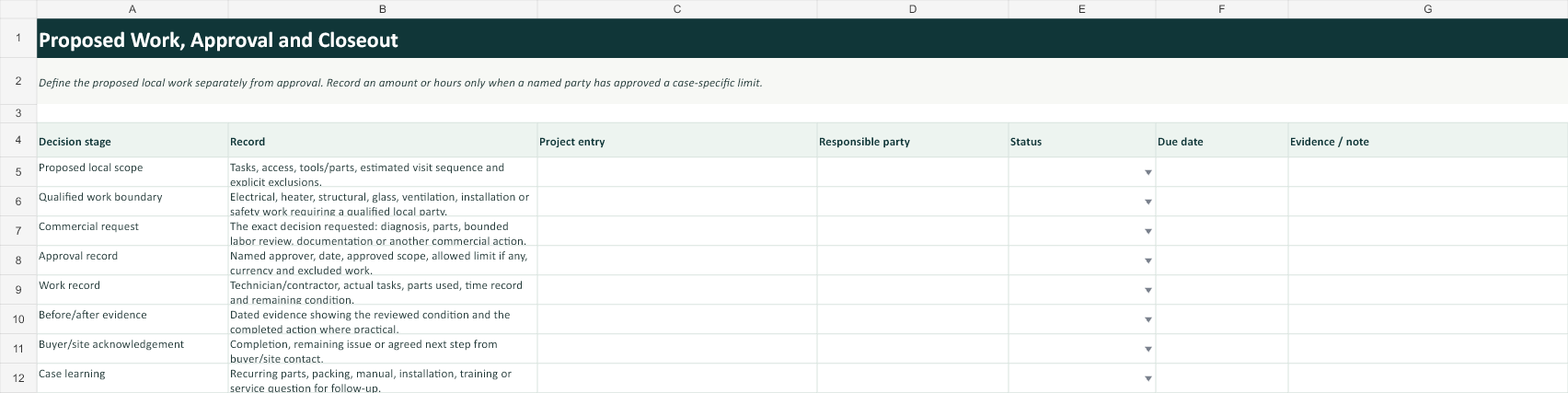
Use this case record to keep evidence, proposed local work, approval conditions and closeout notes together. It supports a case-specific review; it does not set labor rates, warranty coverage, cause, technical safety or local installation responsibility.
- Case and Evidence captures the model, observed condition, labels, factual timeline and missing information.
- Work and Closeout separates a proposed local scope from approval, completion evidence and buyer/site acknowledgement.